November 14, 2010

Mighty Live Oak Trees

Southern live oak trees (Quercus virginiana) have the widest canopy of any tree native to North America. They can reach heights of 80 feet and the canopy spread can be up to twice the height. For an 80 foot tall tree the shaded area under a mature live oak can be 160 feet in diameter. Live oaks can live over 200 years. The reason these oaks are considered “live” is that they are evergreen, only shedding leaves in the spring as new leaf growth begins.

In Texas, live oaks developed and adaptation to Texas soils and environmental conditions that are not conducive for propagation from the acorns. Acorns depend on animals and birds to carry the acorns away from the parent tree. Parent live oaks, to reduce competition from their offspring, encourage a fungus in the soil under the canopy to kill the germination of the acorns. What Texas live oaks do to reproduce, is they send up root sprouts from mature roots. Because the new shoot has access to the mature root system of the parent tree, survival rates are high. Many of these “cloned” sprouts from groves or “motts” as they are call in Texas that can consist of hundreds of trees that all share the same root system. These trees are a subset of live oak called Quercus virginiana var. fusiformis.

A testament to the live oak’s hardwood quality is the War of 1812 Navy vessel U.S.S. Constitution. Its frame was constructed from Southern live oak wood harvested from St. Simons Island, Georgia. The ship survived harsh British war ships' cannon balls that reportedly bounced right off the ship due to the live oak wood’s strength and density – thus the Constitution’s nickname "Old Ironsides" is due to the quality of live oak wood.

As discussed in the last post about soil types on Dogwood, live oaks prefer sandy loam well drained soils, thus they grow best in Dogwood’s sandy loams rather than the clay.

Although the brush under the live oak trees provide good cover for deer and a variety of birds, Dogwood’s mature oaks are to majestic and beautiful up on the hill not clear out underneath them to show case the trees. We have made the decision to clear out oaks and provide other cover and resources to make the deer happy.

Once cleared, these marvelous trees are and will be crowning jewels on the hill at Dogwood. So far, we cleared five live oaks. The process began with our now good friend Remedy mixed with water and a little dish soap in sprayer. In the heat of the summer, I sprayed the yaupon and juniper brush that choked and hid the oak trunks and that were growing up into the oak canopy. Mixed with the yaupon and juniper, green vines sporting vicious sharp thorns grew into the brush creating a nasty tangle. We mostly just call these vines “pokey vines” but when blood is drawn from being poked, scratched or tangled up in one, we use other descriptors not appropriate for post on this site. Taking care not the get the poison on the oak or any of its exposed roots, I sprayed the pokey vines also.

Since summer, the Remedy did its job and killed or severely weakened the yaupon and cedar. Over the course of two weekends this fall, we cleaned out the dead brush and that which was missed with Remedy. Unfortunately, I did not take “before” photos before the Remedy treatment, but I did take before and after shots of the clearing work but these will give you an idea of the diffrerence.  Also, why Blogger makes it so difficult to place photos in the blog, I don't know but it is.


Live Oak 1 - Before


Live Oak by Fence - Before

L:ive Oak by Fence - After


Live Oak Mott - Before

Live Oak Mott - After


November 6, 2010

The Dirt on Dogwood

Young field geologists quickly learn that although using a rock hammer to whack a chip off a rock outcrop and examining it through a field magnifying glass is an important investigative step, so is stepping back to take a good look at the overall landscape, horizon to horizon. In my field geology training days (so many years ago I don’t care to reveal the number) I learned to generally survey the field area with a broad 360 degree view before bending down to hammer on rocks, squirt hydrochloric acid on them to see if the liquid effervesces or scratch around for fossils. Taking in the big picture first may reveal changes in vegetation within the field area that give clues to the geology. Such changes could be that one type of tree dominates the hilltop while another dominates the hillside or a certain grass thrives on one side of a gully and scrub brush on the other. These vegetation changes, if naturally occurring, are due to some change from one micro-environment to another – usually soil composition or water availability.

We see similar micro-environments in the soils at Dogwood Ranch and how they impact the vegetation. Visiting Dogwood Ranch for a walk or drive through the property is the best way to appreciate these changes but the next best way is to look at an aerial photograph with a soil survey map overlay.

The National Resources Conservation Service (“NRCS”) division of the United States Agricultural Department (“USDA”) runs the Web Soil Survey, a free online service that will instantly generate a soil map of a designated area up to 10,000 square acres. http://websoilsurvey.nrcs.usda.gov/app/HomePage.htm.

This website also provides valuable information about each soil type on the map, including information about irrigation, surface water sources, water table depths, chemical composition of the soil, how different building material can be effected by the soil type, sanitation issues, natural resources available, wildlife suitability and a great deal more.

In my Web Soil Survey, I designated Dogwood Ranch as the Area of Interest (“AOI”) and then generated a soil survey map.

Dogwood has five soil types; although two are the same soil composition but have different slopes so the map puts them in different categories.

Soil #                    Soil Description                                 Acres in AOI       % of AOI
  8         Bosque clay loam, frequently flooded                      5.7                  12.2%

25         Crockett fine sandy loam, 1-5% slopes                  24.0                  51.3%

26         Crockett fine sandy loam, 5-10% slopes, eroded    7.4                   15.7%

32         Frelsburg clay, 3-5 % slopes                                   8.9                  19.0%

66         Tremona loamy fine sand, 1-5% slopes                   0.8                    1.8%

Soil 8 is on what we call “Old Dogwood”, the original 10 acre tract. Although the description says “frequently flooded” to our knowledge is has never flooded but during a heavy rain, ankle deep water runs from the adjoining pasture across area 8 to the creek.

Growing in Soil 8 is a great diversity in vegetation, including large trees such as red oak, water oak, American elm, cedar elm, pecan, hackberry, mulberry, Mexican plum and, of course, flowering dogwood. Notably, there are no live oak trees in this soil and the one pine “Christmas” tree was planted by the prior owners.

Soil 32 covers all of the open pasture and a little patch on Old Dogwood. This is the Freslburg clay which is basically the left over soil from weathering of calcareous shale and marl. There are no large trees growing area 32 but we did chop down a mesquite tree in the area. The clay is classic Blackland Prairie soil good for supporting grasses and forbs but not so great for mighty live oak trees. In the section of Soil 32 on Old Dogwood, there are 4 small live oak trees. I believe they were planted by the prior owners.

Soils 25 & 26 are both Crockett fine sandy loam, but only sandy in the top seven inches. From seven to 51 inches deep, the soil is clay, creating a claypan under the sand. This means that rain water can seep through the top seven inches of the sandy loam but then reaches what is effectively impermeable clay. The upper layer of sandy loam soil fills with water so if the water cannot seep into or below the claypan fast enough during a heavy rain, the water runs-off the surface onto Old Dogwood (Soil 8) and into the creek. The differences between Soils 25 & 26 is the slope and Soil 26 is more eroded than 25; the composition is the same. Nearly all of the live oak trees, some that must be close to 100 years old, are in Soil 25 & 26.

There is just a little patch of Soil 66 on Dogwood. It is the sandiest of the soils on Dogwood but still contains some clay. There are no trees in this area, only grass and forbs. This history of this general area of the property is that it was fenced years ago from the rest of the property as hay- storage area so perhaps any trees were chopped down years ago.

Careful consideration of the soil information from the Web Soil Survey will be necessary before any significant infrastructure projects begin as constructing a driveway or building on a concrete slab.

Just like the young field geologist using the vegitation patterns to get clues about the geology of the area, we can see the effect of different soil types on Dogwood Ranch by the plants that grow in each.  Come visit to see for yourself.

October 31, 2010

Expert Advice from the State of Texas

Expert advice is what we needed. That’s what we sought last week by inviting Larry Pierce, County Extension Agent- Agriculture/Natural Resources Texas Washington County, and Stephanie Damron, a Texas Parks and Wildlife Department Natural Resources Specialist to visit Dogwood Ranch. We asked for their advice about how to better manage the pasture for cattle and for wildlife.

Our neighbor’s pasture is adjacent to ours and not fenced from our property since we jointly own the cattle herd with the neighbor and the cattle run freely over both properties. The property line is marked by the surveyor’s stakes when the combined 80-acre track was subdivided into our 40-acre track and the neighbor’s 40 acres. Last March, the neighbor lightly disked his pasture. We’ve watched with interest the progress of the grass on his side of the property line all spring and summer. In late summer, the grass in his pastures put-up tall stems with seed heads that waive in the breeze. Now the grass is a light tan color and looks like amber waves of grain.  Its pretty and, I admit, we developed a bit of "grass-envy."  The entire disked pasture consists of this grass with the tall stems and turkey-foot seed heads. There are very few other grasses or plants in his pasture now.

Our pasture right next to his is full of flowering weeds. Weeds three feet high, some with white flowers, some with little yellow flowers and a pale green leafy plant dominate. There is also some grass of the type on the neighbor’s place and a few other grasses. When we drive through the pasture on the Ranger or ATV, we stir-up bugs, grasshoppers and birds. One time we surprised a white-tailed deer doe and her fawn hiding in the weeds. Inevitably, one or both of us starts to sneeze! Our pasture is somewhat unsightly with weeds the cows won’t eat.

As we stood with Larry and Stephanie on the property line they compared the pastures, Larry from an agricultural perspective and Stephanie from a wildlife perspective. They quickly identified the grass on the neighbor’s place is King Ranch bluestem (Bothriochloa ischaemum, var songarcia). The name sounds very Texas-ish but don’t let the name or good looks fool you. Larry explained that KR Bluestem is a noxious invasive grass imported from Asia and Central Europe. It was primarily brought into South Texas (by the King Ranch folks) in the 1920s and 1930s for its drought resistant qualities. When cotton farming declined in Washington County, Texas due to economics and a cotton root fungus in the soil, KR bluestem was introduced to prevent erosion. According to Larry, folks at the time thought that KR bluestem would save the soil, save the county, save Texas and thus save the world!


King Ranch Bluestem
 Things did not turn out that way. KR bluestem took hold rapidly, pushed the out the native grasses in the prairie remnants that remained in the area and invaded, creating single species grass fields. To make matters worse, KR bluestem is only marginally beneficial to cattle and has little advantage for native wildlife. Larry explained that disking a field to encourage KR bluestem, as our neighbor did, only slightly improved the pasture for cattle grazing.  Cows will eat it but it is not their favorite dish.

Asked how to control KR bluestem, Larry explained that so far researchers have not found an effective means to control the grass. Sprays of extremely high Round-Up concentrations can knock it back but the grass tends to grow back. Other usual methods of controlling grasses have not been successful in controlling KR bluestem.  Research continues.

Turning to our pasture, Stephanie explained that from a wildlife standpoint, our pasture was a good habitat for prairie birds. She pointed to three good seed sources: common broomweed (Xanthocephalum dracunculoides), snow-on-the-prairie (Euphorbia bicolor) and Texas croton (Croton texensis). Broomweed and croton are forbs, which are non-woody flowering broad leaf plants that are not grass. Snow-on-the-prairie is a euphorbia, kin to succulents and poinsettias. The white “flower” giving the plant its name “snow on the prairie” is not really a flower but is nonetheless referred to as a “wild flower”.

Texas Croton


Broomweed


Snow-on-the-prairie
 When the snow-on-the-prairie plants were tall and blanketed the field with white blooms in July and August, we noticed the cattle would not even walk through that portion of the pasture. The reason is that the plant is a euphorbia and like all  euphorbia, has a milky white substance in its stems which is an irritant, especially to the eyes. It is poisonous if ingested. Cows aren’t particularly smart, but I guess they aren’t so stupid as to eat poisonous plants. Now that the “snow” has melted, so to speak, with the white flowers gone and stems dried, the cows will graze on grass through this area of the pasture. In addition to the croton, snow and broomweed, our pasture has KR bluestem and some sprigs of the native prairie grass silver bluestem (Bothriochloa saccharoides var. torreyana).

After talking with Larry and Stephanie, we’ve decided that we don’t want encourage the KR bluestem to take a stronger grip on our pasture. Eventually we plan to convert the pasture to native prairie grasses that both cattle and wildlife prefer. We realize now that this may be an even bigger challenge than we anticipated as first we have to knock back the KR bluestem enough for other grasses to have a chance.  Then the restoration area must be fenced off from the cattle who will eat the new grass as it comes up preventing the grass from becoming established.

Larry and Stephanie also discussed state and federal programs available to assist landowners with certain agricultural and wildlife activities. We are going to look into those in more detail. They also strongly recommended that we meet with a local representative from the U.S. Department of Agricultural who they say is the most knowable about soil and erosion concerns and federal programs to assist landowners with these issues. We have some erosional features on the property that we need to address.

We also inquired about why, over the last 18 months, large mature oak trees that looked healthy on Old Dogwood fell over, full of green leaves. Larry’s suspicion is a cotton root rot fungus that still infects the soil in the area from days when cotton was king. He also suggested we get the local U.S. Forestry Service representative out to look at the woods on Dogwood Ranch which he believes are unique in area.

I am now reaching out to those federal resources to investigate further what we should or should not do with the land and what assistance, if any, is available to assist us (without too many federal government strings attached!).

October 24, 2010

The Rainbow Bridge


Old Dogwood has a seasonal creek that divides the property 1/3 on the “other side” of the creek and 2/3 on the driveway side of the creek. The “other side” is heavily wooded and the wild side. From about May through December, the creek is dry with white sand in the bed which varies from a few feet deep to over 10 feet deep in the area we call the “Grand Canyon of Dogwood.” From January to April it often has a small stream of water trickling down about ankle deep in most places. The creek rises quickly during a heavy rain, up to several feet deep.

Soon after we acquired Old Dogwood, we realized we needed a way to easily cross the creek, dry or wet. We also wanted to take equipment and the mower to other side. To do that, we needed a bridge. We decide to build a rainbow or arch-type bridge to span 25 feet across the creek with a seven foot width. Like with nearly everything these days, bridges are for sell over the internet. A nice fellow, Frank Petersohn, in Sechelt, British Columbia, Canada had a rainbow bridge design for sell via the internet. Browse his website at http://mathemati.ca

We gave Frank the bridge dimensions we wanted and that it should support 1600 pounds. He modified his design accordingly, cut the lumber to size with the correct angles for assembly, provided the hardware to hold it all together and assembly instructions. The only lumber not provided were the planks as those were standard size and easily purchased at any lumber yard or home improvement store.

The bridge pieces were shipped by freight to us and delivered to our gate at Dogwood. On our usual route from Highway 290 to Dogwood, there is a small wooden bridge over a creek. The bridge is not marked with a load capacity. When the freight truck driver got to that bridge on his way to deliver our bridge, he refused to cross the unmarked bridge for fear it would not hold his truck and his load. He called his dispatcher to find him another back road route to Dogwood.  The bridge was transfered from the freight truck to our truck for the 50 foot drive from the gate to the garage.


We decided to build the bridge in the front part of the property and built most of it during December 2003 when there was no water in the creek and the weather was not too hot to work hard. Before the building could begin, concrete footers were constructed on both banks to support the bridge. Frank’s site shows in detail how those were to be constructed.


We did this by digging a hole 2 feet wide, 6 feet long, and 2 feet deep and filling it with cement. Each footer required 12 80-lb bags of cement. Getting 12 8-lb bags of cement across the creek was a challenge. Each bag was wheeled over and pushed up the bank in a wheel barrow one at a time. To wet the cement, we strung three long garden water hoses from the well house, across the property and across the creek to the footer location. Rebar was added to the wet cement slurry for strength.

Form for the footer


Moving one bag of cement across the creek


Mixing cement in the wagon
 
Autographed cement footer


The bridge was then constructed per the designer’s recommendations. By Christmas 2003, we had an attractive bridge and a way to drive across the creek! It has served us well over the last seven years and remains sturdy. It official opening ceremony with family was in February 2004.


Trusses built


Official Openning Ceremony


Just water under the bridge


Go  to Frank’s site, click on photos and the Dogwood bridge is featured in the third column, the fifth picture down. http://mathemati.ca/1_24foot.html
The bridge was a big project, one of the first of many at Old Dogwood needed simply to make the place more habitable and easier to get around. However, today, if we drive the mower or ATV over the bridge, we cannot complete the loop and cross back at the other end of the property because we do not have a bridge in the back of the property. That is about to change and we hope to complete the next bridge project by the end of 2010. It is a different type of bridge and will be built from different material. The Cedar Bridge Project has been underway for two years but the construction phase soon begins.


October 18, 2010

Installing the Diffuser

Installing the pond diffuser was a six-Advil project: two before starting work, two after finishing the work and two more at bedtime that night. It was also a two-hardware-store-visit job during the middle of the project.

An objective during this installation was for neither of us to get in the water at all! Although the fish, turtles, frogs, deer, birds and other wildlife like this water and it is safe and beneficial to them, it is not fit for human swimming or for human ingestion.

First, take a look at the diffuser and the air pump in the photos below.


Air pump, diffuser and air tube
 We ordered an electric genAir 484 that is designed to run constantly for seven years. The diffuser itself is a fairly simple device and hooking it up was not difficult. The green box is the air pump. The black tubing is hooked to the pump and the other end is hooked to the diffuser, the black square with the two round pieces attached on top. When the air pump is on, air flows through the tube and blows out the tiny holes in the two disks.

After wiring an electrical outlet in the well house (using supplies left by Dogwood’s prior owners) and finding a stable surface for the pump and testing it, we ran the 50’ weighted tubing that came with the diffuser from the pump in the well house down the slope toward the pond. Oops! The 50’ of tubing just barely reached the waters’ edge. To get the diffuser set even close to the center of the pond, we needed at least another 50’ of tubing; thus, the trip to the first hardware store. Since we figured the local hardware store would not have the specialized weighted tubing meant to sit is water for years, we decided to buy whatever proper sized tubing we could find and bury it from the well house to the pond in one inch PCV electrical pipe. We would fasten the weighted tubing that came with the diffuser to the end of hardware store tubing, hook it to the diffuse and run it out in the pond.

I started at Tractor Supply up on highway 290 just east of Brenham. I found a 50’ coil of the right size tubing but it was designed to spray agricultural liquid chemicals. I got it along with several sizes of clamps and couplings. I also made four calls back the Dogwood to make sure I was buying the right stuff. Unfortunately, Tractor Supply does not carry PVC pipe so, it was off to the local Home Depot where I bought 50’ of electrical PVC pipe which we could easily connect together. The sales staff at the Brenham Home Depot is very helpful and friendly, much more so than in the Houston Home Depot stores.

Meanwhile, back at the Ranch, Ronnie started the real work – digging the 50’ trench from the well house to the pond to bury the line so the cows don’t step on it and crush it or pull out the connections. What made this job so hard is the “black gumbo” soil on Old Dogwood. When it’s wet, it is gooey and sticky – it cakes on your boots making them heavy and it won’t drop-off the shovel unless scraped off. Digging and scraping makes for hard slow digging. But, when the gumbo is dry, it seems hard as cement and takes a pick axe to make any headway. That’s how it was digging this trench; it was dry, hard like cement. We took turns using that heavy pick-ax and then scoping out the dirt. I can’t swing the pick-ax because it is so heavy so I just hack at the ground. We dug the trench just a few inches deep.


Trench
 We decided that before finishing the trench and burying the pipe, we should deploy the diffuser in the pond. To do that, we hooked the air tubing together and to the diffuser, filled the diffuser base with sand (dug from a dry creek bed in the woods up the hill), put the plug in and tied a rope onto the diffuser base. To the end of that rope, we tied a longer rope. While one of us held the tubing in place at the end of the trench, the other took the long rope and walked to the other side of the pond. Once we were right across from each other, Ronnie slowly pulled the rope toward the other side of the pond and diffuser slowly sunk into the pond blowing bubbles. We had it turned on so we could see where it was as it moved underwater. As Ronnie pulled on the rope the diffuser moved toward the center of the pond. When all of the slack was nearly out of the tubing, we stopped and let the diffuser settle into the muck on the bottom, blowing bubbles all along. I was pretty impressed we managed to get it done without either of us getting wet! The diffuser is not quit in the center of the pond but close enough to do the job.

The next morning we finished digging the trench. Worried that once the pond filled to capacity again the PVC might float up our of the trench, we used some old cinder blocks and cinder block pieces to hold the pipe in place. We ran the PVC through the holes in the cinder blocks and buried them in the trench.

PVC held down by cinder blocks ready to be burried

The change in the pond is going to take some getting used to. The bubbling on the surface of the water is fairly gentle but every now and then it gurgles and splashes. At times it sounded like the creature from the Black Lagoon starting to rise out of the water! We hope that when the pond is full, there will be a bit less splashing but it’s really not loud, just different. Our next task is to determine if we need to restock with fish and if so, what kind.

Diffuser bubbling in center of pond


October 13, 2010

Fish Kill

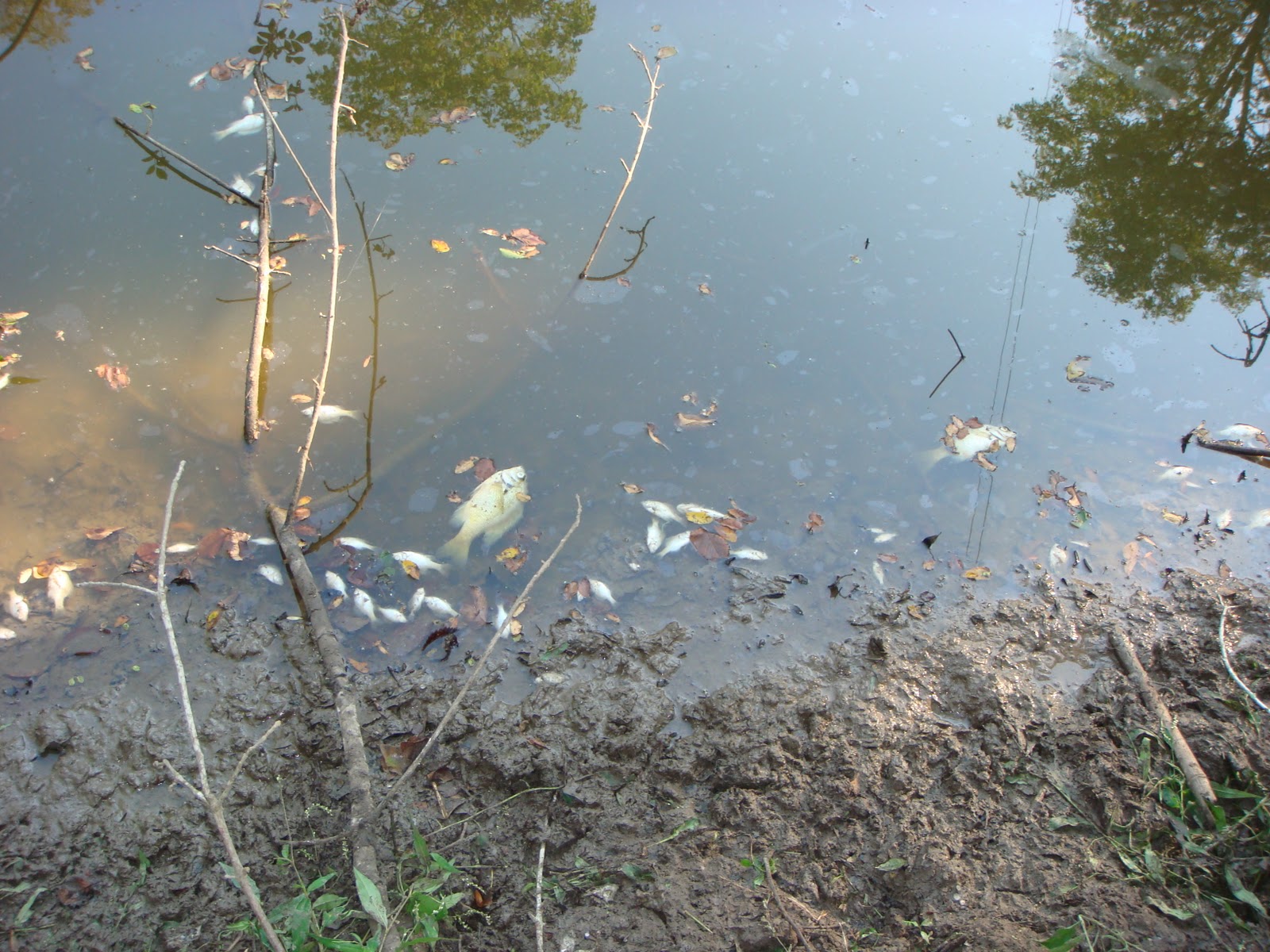
No evidence of dead fish remained when we arrived at Dogwood the week after we discovered all of the dead fish floating on the water. The buzzards, vultures, owls and other scavengers did their job and cleaned up the mess, including the bones. The turtles seemed happy enough swimming around and the usual frogs serenaded each other with their croaking Friday night.

Here’s more information about what we now know has an official name: “Fish Kill.” It’s always nice to have an official name to put on a problem because it means someone else has dealt with it before and may have a solution. Fish kill is a common enough problem that there are lots postings on the internet about it and how to prevent it.

Fish kills are due to what we suspected right away: low oxygen concentration dissolved in the water. Incidents usually occur suddenly, like it did at Dogwood Ranch, resulting in fish suffocation during the early morning hours. The reasons for this take us back to chemistry class.

Warm water does not hold as much oxygen as cool water. Fish metabolism increases in warmer water so they require more oxygen as water temperature rises. Oxygen levels in water are lowest at dawn because aquatic plants do not photosynthesize at night, so less oxygen is released into the water at night. Fish swimming near the surface of the water or near the shore right before daybreak and gulping for air is a good sign of oxygen depletion water.

There are several causes of oxygen depletion in nutrient rich ponds: (1) the die-off of a large algae bloom; (2) decay of weeds in the water after treatment with an herbicide; (3) turnover of oxygen-poor bottom waters following a thunderstorm; and (4) runoff of livestock waste and other organics after a heavy rain. Since we know we did not use any herbicides near the pond and certainly not in it, 2 is probably not what happened. According to the rain gage, Dogwood did get a drop of rain for nine days prior to the fish kill so we do not believe 3 or 4 were the cause.

We believe that 1 is the most likely cause of the fish kill. The pond is nutrient rich due to the run-off of manure from the pasture and the cows generously dropping manure in and around the pond. During the day, algae produce and release oxygen as a by-product of photosynthesis. This is a source of oxygen in fish ponds like at Dogwood. At night, plants consume oxygen but algae blooms usually produce much more oxygen during the day than is consumed at night. But, under certain circumstances, there is reduced oxygen produced during the day while the oxygen consumption at night remains the same. If the nutrients algae use (like nitrogen from cow manure) is used up without influx of fresh nutrients, the algae bloom decreases, a natural oxygen source is temporarily lost leading to low oxygen levels in the water and the fish suffocate and die.

According to The FishSite at http://www.thefishsite.com/articles/289/oxygen-depletion-and-other-types-of-fish-kills: “Extremely calm days may also reduce photosynthesis and oxygen production, even under sunny conditions, by preventing phytoplankton [algae] in the middle layers of the pond from mixing near the brighter surface. In summer, oxygen problems may arise because of a simple physical property of water. The warmer the water, the less dissolved oxygen it can hold. When a dense bloom produces a surplus of oxygen on a summer afternoon, the oxygen will not stay in solution and escapes into the atmosphere. During the night, the bloom attempts to take more oxygen out of the water than what remains from daytime photosynthesis. When this occurs, dissolved oxygen levels approach zero. Fish begin to suffocate in the pond, and aeration must be applied to meet the demand for oxygen and prevent fish losses.” Similar conditions seem to be what caused the fish kill on Dogwood Ranch.

Since a week later there was absolutely no evidence of the fish kill remaining at Dogwood, perhaps fish kills occurred in the pond before but were not noticed due to when they occurred. For instance, if the fish kill occurred on a Monday morning, it is possible the scavengers cleaned it up before our arrival the following Friday night or Saturday morning. Moreover, in the summer, Dogwood can be unbearably hot and humid, so we do not go out there every weekend June through August. If fish kills happened before and we just might not have know it.

To prevent another one, we ordered a diffuser and hope to install it in the pond this weekend. A diffuser is a device that sits on the bottom of the pond. It is connected to a tube that runs to bank and is connected to an electric air compressor. The compressor, which we will keep in the well house plugged-in to electric power, will push air through to the tube to the diffuser at the bottom of the pond. The air pumped into the diffuser will blow out hundreds of tiny holes sending the resulting tiny bubbles floating up through the water column. The bubble will add oxygen to the water and help circulate the water at the bottom of the pond to the top. A pond diffuser is like the device used in a fish tank for the same reason, it’s just a lot bigger. We chose a diffuser over an aerator fountain for two reasons. One, the fountains type of aerator that you may see in ponds in city parks or retention ponds in neighborhoods or developments only aerate the top few feet of water column If the pond is deep, 12 feet or more, that still leaves most of the water at risk for oxygen depletion. Second, I think a fountain, although attractive in a city park or in front of an office building, would just not look right spraying up in a pattern at Dogwood. To me it would spoil the natural look and sounds of the pond.

We hope the diffuser will help prevent fish kills in the future and overall increase the health of the pond, cows or no cows! The next challenge is hooking-up the diffuser and sinking it to deepest part of the pond possible, without getting wet ourselves.

October 3, 2010

We Killed the Fish and the Vulture’s Feasted

Healthy. That’s always been the description of the pond on old Dogwood. Fish flopped in the water, turtle’s sunned on logs, bull frogs splashed and croaked, and water birds came to the shore for food. That all changed, seemingly overnight.

Yesterday we arrived at Dogwood on a spectacular and gorgeous morning with the beginnings of fall in the air. I got out of the truck to open the gate, expecting the freshness of the country when I inhaled. Instead, when I took a deep breath, instantly I got a faint scent of death on the breeze. As I walked up the drive and got even with pond, the smell was no longer faint, but down right strong and foul. A big black buzzard flew up from the pond shore into a tree. I noticed other buzzards in the trees. Not a good sign. I was fearful a cow had died in the pond.

After getting our stuff out of the truck and opening things up, I went back to pond to investigate. I saw a bunch of white things floating in the water. Relieved that it probably was not a dead cow, I was not prepared for the truth. Moving closer to pond’s edge I realized the white things were fish, lots of them and of all sizes. All of the fish were floating on their sides dead in the water. Dead catfish, perch and bass littered the shore and water. I didn’t realize there were that many fish in the little pond until that moment but they were floaters rather than swimmers.


We had little rain in the last month, the water level was low. What we believe, but have not yet confirmed, happened is that the low water level along with the nitrogen the cow’s manure caused an anoxic environment in the pond. Fish cannot live without adequate oxygen in the water so they died. We have an appointment in a few weeks with the county agricultural agent and the county biologist to help us determine how to improve our pasture grass, but now we will include how to fix the pond to the discussion.

We of course take full responsibility for this tragedy and smelly mess. However, I’m going to use the situation to get on my soapbox about the State of Texas’ supposed encouragement of landowners to use their property for wildlife activities. Property taxes on raw land can be high. However, Texas, like most states, offers incentives to landowners who engage in agricultural activities on the land. Such activities include raising crops for human or livestock consumption, growing cotton, raising livestock, keeping bees, maintaining a hay field and many other activities. In order to encourage agriculture in the state, land used for agriculture purposes qualifies for an agricultural tax valuation, or the so called “Ag Exemption.” This tax break can save the landowner 70% or more on property taxes. To establish the Ag Exemption, agricultural activities must occur for five consecutive years on the property. After five years, the property has established an agricultural history and receives the Ag Exemption. So long as an Ag activity continues on the property, the property is subject to the landowner-favorable Ag tax exemption.

Texas also recognizes a wildlife tax valuation for land, the so called “Wildlife Exemption” with the same tax savings as the Ag Exemption. But, here’s the problem. Unlike the Ag Exemption, a landowner cannot go from no exemption status straight to a Wildlife Exemption. The law only allows property that already has an Ag Exemption to convert to a Wildlife Exemption. So, a property with no exemption status must first spend five years establishing a agricultural history and obtain the Ag Exemption to be eligible to convert the Ag to a Wildlife Exemption.

Old Dogwood with the pond had no exemption when we bought it in 2003. Although we have engaged in qualifying wildlife activities on the land for seven years, because it does not have an Ag Exemption, we cannot obtain a Wildlife Exemption. For seven years we paid Washington County full freight on property taxes while our neighbors with much larger properties only paid a fraction of the tax we paid because they had Ag Exemptions. When we purchased the neighboring 40 acres last November, the property was transferred to us with an over 60-year agricultural history and an Ag Exemption. That is why we also purchased the sellers cattle herd, to maintain the Ag until we were able to convert to a Wildlife Exemption.

We realized that if we could now allow the cattle to graze on old Dogwood, in five years it would have an Ag Exemption and then we could convert the entire 50 acres to Wildlife. We understood the cattle would drop their manure on the place, stomp–up the shore around the pond and create a trail to the pond. Sure enough, they did all of that but we thought it a little price to pay for the future ability to convert the property to a Wildlife Exemption and significantly reduce our property tax bill.

The problem with the pond probably could have been avoided with proper management had we considered the addition of the cattle; nonetheless the idea that the State of Texas requires us to destroy or potentially damage the wildlife habits on the property before we are allowed to qualify for a Wildlife Exemption seems backwards-in other words, government-like. But that is the case. I am concerned the cows may be causing other damage that we haven’t noticed yet.

We hope the vultures and buzzards do their clean-up job during the week so that the fish and the bad smell are gone next weekend. All of these years we left the pond alone as it was alive and healthy. Now, from our own ignorance and failure to inquire with experts on what the cows would do to the pond without some sort of intervention from us, the pond is dead or close to it. We feel awful but, don’t worry; we will get proper advice on how to bring it back to life and how not to allow it happen again. It may be as simple as aeration of the water. We shall see and will report back.

October 1, 2010

Don’t Drive the Tractor into the Pond!


John Deer Mower
 Soon after acquiring “old Dogwood” in 2003, the first piece of equipment we bought was the tractor. Actually it was the topside of John Deere’s riding mowers, the next size up was a real tractor. That poor mower/tractor has taken a lot of abuse: from being driven into the pond, getting stuck in the mud, mowing blades stuck in and bent by tree roots, to nephews riding it around the field on cruise control for fun.


Let’s get the driving the tractor into the pond story over with as it was not one of my proudest moments. Water is supplied to the pond by rainfall and runoff from the pasture to the east. We also believe there is natural seep or small spring feeding the pond because the water never drops below a certain level, even in drought conditions. The west bank of the pond is a little steep as it is the dam that keeps the water from flowing out the other side. One day I was just mowing along, minding my own business, probably in too much of a relaxed state of mind. I came over the dam heading toward the pond’s edge. Usually, I go about half way down, put the mower in reverse and move on without any problem. This time, I went a little more than half way down and gravity took hold and did its thing and the mower starting rolling towards the water. When I tried to put the mower in reverse, it keep going forward! It slowly rolled into the mud and in what seemed like slow motion, I watched the front end go into the water. I killed the engine and it kept rolling until I finally was able to get the brake set. Only the front end went in the water but we had to tie a rope on the back of Ranger to pull it out. Nothing was damaged or hurt, except my pride.


The pond without the tractor in it

I must admit, there is a certain peacefulness, a Forrest Gump like serenity, to just mowing the grass on a riding mower. The peacefulness comes from the simplicity of the task of just mowing the grass although some decisions take some thought. For instance, at the beginning of the task, I have to decide if I am going to mow in a square pattern or go back and forth in lines or do some wild and crazy pattern. Since Dogwood Ranch (the portion we keep mowed, the “civilized area”) has many trees, periodically during the mowing process there a decision point on which way to go around the tree, right or left. Sometimes I decide to circle close and go all around the tree, twice. Sometimes I mix it up, go right around the first tree and left around the next, but no matter which way I chose, or what mow pattern is used it really doesn’t matter, so I go with what I feel like doing at the moment. There are just not too many things in life that I feel free to do just because I feel like it.

Mowing is also a satisfactory task. At the end of the day, I look out over the two acres  just mowed and I see the results of my labor right away and it looks good. In fact, even during the mowing, there is something satisfying about the dramatic swath of mowed grass next to the tall un-mowed grass I’m about to cut down. I do not get that satisfaction in my “day job” shuffling paper, managing hordes of email each day, sitting in meetings that often drone on much to long and talking on the telephone. At the end of a long day in my day job, it is difficult to tell what all of my hard work accomplished because it is not a tangible thing. There is nothing I can see that I did before I turn out the office light, shut down the computer and go home. When I walk out the door I don’t say “looks good.”

It takes us about 4 hours, in two shifts, to mow the entire “civilized” area. But when we are finished and the tractor is cleaned and put away, we look out over the property, put our hands on hips and say, “Wow, the place really looks great!” Simple, but satisfying – but don’t drive tractor into the pond!

Here a few photos of the John Deere.


Pulling an improvised harrow to rough the soil to plant wildflower seeds


John Deere pulling the wagon and giving the nephews a ride


September 30, 2010

Invasive Brush Plants - Part 8 - Mesquite

Mesquite or honey mesquite (Prosopis glandulosa var. glandulosa) is one of the toughest, most invasive species of brush in the world according to Texas A&M’s Brush Busters. http://www.cattlementocattlemen.org/uDocs/BrushBusters-Mesquite.pdf/

Biologically, mesquite is classified as a legume. Other legumes you may be more familiar with include clover, alfalfa, peas and beans. The legume family’s claim to fame is that these plants fix nitrogen in the soil. This ability to fix nitrogen is why clover or alfalfa are often used as cover crops to increase nitrogen in the soil for the food crop. I was surprised to learn that mesquite falls into the legume family but I should have known since trees produce long bean pods. Because mesquite is a legume, you may notice that grass growing under the mesquite is greener than the grass growing away from the tree. This is not because the tree shades the grass from the harsh sun but because the grass is benefiting from the nitrogen rich soil under the tree. Nonetheless, mesquite in invasive quantities is undesirable.

At Dogwood Ranch, we do not have a serious mesquite invasion such as many ranches in South Texas. We want to keep it that way through vigilance. Dogwood Ranch only has a few large mesquite trees. As we discovery small saplings in the pasture, we zap them with Remedy right away. Mesquite, like yaupon, cannot just be cut down or shred because it will come back and spread. The roots must be die to kill the tree.

The first large mesquite tree was tackled is chocked up to a live and learn experience. We cut the 9 inch diameter tree down with the chainsaw and then applied Remedy to the stump. So far, so good. From there, we chopped-up the branches and the trunk and drug them across the field to the usual burn area. That was the mistake. When we drug the thorny branches across the pasture, some of the thorns broke off and are now laying in wait on the ground to puncture tires or soles of boots. The next weekend after we chopped down the tree, the brand new UTV (utility terrain vehicle the “Ranger”) got three thorns in the tires requiring patches.

Even worse, we transported mesquite thorns to the burn area on the “old Dogwood” that never has had mesquite. As a result we ended up with thorns in our boots and and area we avoid on the ATV.

Because of this experience, a new plan on how to deal with the large mesquite trees has hatched. In July, we mixed a strong batch of Remedy and water. I sprayed the trunk of the two large mesquite tree all the way around from the ground to about 5 feet up the trunk. Major limbs at that level were sprayed also. At last check two weeks ago, the leaves were starting to turn yellow. According to our neighbor who more mesquite on his place, best practice is to spray the tree but do not cut it down for a year. The lore is that it takes about a year for the roots to completely die. He mixed his spray ½ Remedy, ½ diesel but I think that a little over kill. However, his trees certainly look deader and ours!

After we are sure the trees are dead, we will chop them down and burn them in place, rather than drag them across the property.

Here are a couple of links to sites about Mequite control. http://www.livestockweekly.com/papers/98/11/12/whlbrush.asp

http://coastalbend.tamu.edu/NLO/Resources/BB%20Mesquite%20L5416.pdf

September 29, 2010

Invasive Brush Plants - Part 7 - Juniper or Cedar

Now that we have discussed why we want to clear the juniper, let’s chat about how we do it. Basically, there is one method we use to clear juniper – cut it down. Unlike yaupon, it will not come up from the roots. The small saplings we whack down with the machete. For the trees, the chainsaw is the only way. The problem with the juniper is what to do with the tree after it is chopped down. If it is in the woods, sometimes we will just let it lay where it fell and become cover for birds and small mammals and eventually rot. If we don’t want to leave it, we use the chain saw to cut the limbs and drag them to the burn area.
You have to be careful working with it because the leaves or nettles are pokey and itchy, especially when they fall down your shirt or get in your breaches. Wearing gloves is a good idea. Because the trees have sticky sap, don’t sit on a freshly cut stump or you will have a sticky backside! The cedar does smell nice when cut.

Burning juniper is pretty much a mess. There is so much moisture in the leaves when green that they create a lot of white smoke and if piled on too high, will snuff out the fire. It’s best to let it dry out a few weeks before burning. Even then it is a mess. When the sap heats in the fire it pops, sometimes shooting small burning pieces out of the fire ring. The foliage initially goes up in huge flares and the burned needles can float on the smoke carrying a spark. We don’t burn juniper if the area is dry or if there is burn ban in the county as it is too dangerous.

We are experimenting this year with a twist on the “just cut it down” method by ringing the tree and letting it die in place. We used the chain saw to make a cut about an inch deep through the bark all the way around the tree. On some, we then used a paint brush to put Remedy in the cut and some we did not use Remedy. In a few weeks the leaves starting turning brown on all of the ringed trees. We are hoping the advantage of this method will prove to be that the tree dies, the thick leaves fall off and let light in to the grass. Once the leaves are gone, we can chop down the tree with much less mess and less burning. We ringed four or five large trees last spring and are monitoring their “progress”. I will report back on how this process works.

Even though we strive to eliminate most of the juniper, it does have some useful purposes. We use the limbs for replacement fence posts. The fences around Dogwood Ranch are about 60 years old and many of the old cedar fence posts have rotted and are falling down. In some areas, only brush is holding up the barbed wire. We are also in the process of building a bridge over the creek with boards we cut from the large cedar trunks. It has taken about 2 years to cut enough boards and beams but we plan to finally start building the bridge this fall. It needs to be strong enough to span 25 feet and hold a John Deer mower and one adult. I will report on bridge building progress later this fall.

September 26, 2010

Invasive Brush Plants - Part 6 - Juniper or Cedar

Juniper, also called Texas cedar (Juniperus virginiana) has a few redeeming qualities: 1) it makes good fence posts; 2) we can build things from it and 3) the barred owl roast in them during the day for cover. Nonetheless, for the most part, the cedar is not good in invasive qualities.  Here is a real world example. On the my blog post dated September 11, 2010, there is photo of the American flag in a holder mounted on a juniper stump. The trunk is about 6 inches in diameter and the tree was probably 30 feet tall and sported thick green foliage. The grass under the tree and in its dense shadow never really grew well, didn’t turn deep green and was thin. We cut off the top of the tree in the winter. The following spring the grass around the stump and where its dark shadow used to fall was thick and green like never before.

Thick shade of juniper trees

Regardless of our obversations and the opinions of the county AgriLife agent and biologist, some family and friends are unconvinced that we should remove so much juniper. They feel the trees are pretty and that destroying them is not environmentally appropriate. Therefore, before discussing our methods of juniper removal on Dogwood Ranch, I will review some scientific information provided some folks much smarter than me.  Recall from the post describing the Blackland Prairie vegetation zone that although juniper may be native to the area, before European settlement, the brush was controlled by frequent naturally occurring fires so it did not become invasive.

According to Thomas L. Thurow and Justin W. Hester in their paper “How An Increase or Reduction in Juniper Cover Alters Rangeland Hydrology”, http://texnat.tamu.edu/symposia/juniper/TOM2.htm : “Increased dominance of juniper in what had previously been grasslands or savannas substantially alters the fate of precipitation on rangelands. This has very important ramifications because water is a direct or indirect limiting factor to all aspects of production on semi-arid regions.” Thurow and Hester explain that the increase or decrease of juniper changes the natural hydrologic cycle. You may remember studying the basic hydrologic cycle in 5th grade science class but see the USGS’s diagram as a quick refresher.


Thurow and Hester describe how changes in juniper cover disrupt several processes of the natural hydrologic cycle: interception, infiltration, herbaceous production, evapotranspiration, runoff, deep drainage and erosion.

Interception loss is loss due to interception of rain before hits the ground. Thick juniper canopies intercept the rain drops and reduce the amount of rain that reaches the ground.

Infiltration is the process by which water moves into the soil. Increased infiltration is one cause of increased erosion when juniper invades the range.

Herbaceous production, or growth of other plants such a grass, are often negatively impacted due to juniper-induced reduction in light, soil moisture and nutrients. What we observed unscientifically on Dogwood Ranch, Thurow and Hester describe as follows:

“Juniper is an evergreen with extensive lateral and deep roots, and it has physiological adaptations which enable it to extract water from very dry soil. In addition, juniper also has a dense mat of fibrous roots at the soil surface. These traits make juniper a very strong competitor with grass for water, both underneath the canopy and in the tree interspace. Numerous studies have documented significant reductions in grass production due to increased woody dominance underneath the canopies. . . .When juniper roots grow into the spaces between trees to compete for water and nutrients, this competition, especially when combined with grazing pressure, puts extreme stress on the grass. This can explain why grass in the juniper interspaces may often be sparse, lack vigor and are difficult to reestablish as long as the juniper is present. Another competitive advantage of juniper is that it is not as quickly affected by drought as herbaceous species because the trees have a deep root system which gives them access to a water source that the herbaceous species cannot effectively tap.”

Evapotranspiration consists of evaporation and transpiration. Transpiration is water vapor released in to the atmosphere by plants while evaporation is water vapor released from water sources or the soil into the atmosphere. Although water evaporation is less under the juniper tree due to the thick canopy creating a microenvironment of shade and reduced wind, the increase interception caused by the thick canopy increases evaporation. This is because the water on leaves and branches evaporate quickly before it can be transpired by the plants. More precipitation is lost to evaporation in juniper woodland than grass land. “Juniper has a very extensive rooting system compared to herbaceous plants, and therefore when it invades a site, it has access to a greater volume of soil water. . . .Juniper can continue to remove water from the soil long after grasses have gone into a drought or temperature induced dormancy.

Juniper seems to have little effect on runoff but negatively impacts deep drainage. “The combination of less water entering the soil and strong ability by the juniper to extract water means that little water has a chance to drain beneath the root zone.”

Finally, juniper invasion also can cause increased erosion in the interspace between the trees because the juniper often has out competed the grass and bare soil is exposed.

I hope the above explains why we are aggressing removing juniper from Dogwood Ranch. We hope to improve our chances of restoring the Blackland Prairie grasses with the juniper held closely at bay, if not totally gone. Never fear though, as we will never be able to eliminate all the juniper on Dogwood Ranch by our manual methods. Also, some of the tall old juniper in the woods we will not disturb as the barred owl uses it for cover during the day.