August 28, 2010

History of the Brenham Area

Brenham, Texas, originally called Hickory Grove, changed its name in 1843 to Brenham in honor of Dr. Richard Fox Brenham a Republic of Texas hero of the Mier Expedition. It was the prisoners of the Mier Expedition who were subjected to Santa Anna’s so called “Black Bean Incident.” Dr. Brenham had practiced medicine in the Hickory Grove area.

In 1841 President of the Republic of Texas, Mirabeau B. Lamar, asked Brenham to serve as a civil commissioner of the Texan Santa Fe expedition, which embarked to bring the city of Santa Fe and trade along the Santa Fe Trail under the control of the Republic of Texas. The mission failed and Brenham and his “Santa Fe Pioneers" were arrested and imprisoned in Mexico City. Brenham was released in April 1842 and returned to Austin, where he joined the Somervell expedition against Mexico. When William Somervell ordered his volunteers to disband and return to Texas despite their success in capturing Laredo, Texas, and Guerrero, Tamaulipas, Brenham joined with others who were unwilling to return home. This group set out for Mier, Mexico on the Mier expedition. On December 23, 1842, the group crossed the river and occupied Mier unopposed. The next day the Texans vacated the town and went back to their camp but required the town to deliver certain supplies to the camp. However, Mexican General Pedro Ampudia arrived at Mier and prevented delivery of the supplies. On Christmas Day, the Texans entered Mier again, this time by force although outnumbered10 to 1. After fighting into the next day, the Texans suffered 31 killed and wounded and the Mexican’s losses were estimate at 600 dead 200 wounded. Nonetheless, the Texans were nearly out of rations and agreed to surrender but the terms were not well defined.

The prisoners were first sentenced to death but that sentence was later lifted. The prisoners were held at Matamoros but orders came to move them to Mexico City. On the route to Mexico City, the prisoners revolted and many managed to escape near the town of Salado on February 11, 1843. Brenham was killed in the fighting. All but three of the escaped prisoners were re-captured.

After the escape attempt, all 176 surviving prisoners were sentenced to death. However, Santa Anna, after promising foreign minsters he would show mercy, had the sentenced changed to death for every 10th man, to be determine by lottery. All prisoners were forced to draw beans from a jar. Those that were unlucky and drew a black bean were lined-up and shot. Later that year, Hickory Grove changed its name to Brenham to honor the local area doctor Robert Fox Brenham. If you want more information about Texas history and Texas historical figures, a good starting place is the Texas Handbook Online. http://www.tshaonline.org/handbook/online/


The Brenham post office was established in 1846 and by1858 the new county seat was a thriving agricultural center area and the town of Brenham was incorporated. Brenham served as the terminus of the Washington County Railroad built in 1860, and was a distribution point for goods to Texas’ interior until 1871, when the Houston and Texas Central Railroad was extended to Austin.

The area suffered a yellow fever epidemic 1867 and federal occupation forces burned many of the commercial buildings during Reconstruction in 1867 following a confrontation with local citizens. The mass grave of those claimed by yellow fever is marked in a local cemetery. There were also destructive fires in 1873 and 1877.

German immigration began in the county in the 1850's and increased after the Civil War. Large farms were divided into smaller ones and worked by German immigrants. German immigration to the area peaked in 1880s. A look around the area at road signs and the names of local businesses today  the German and Czech influence is still apparant. For instance, there are roads named Adamek, Beckemann, Boehmemann, Berlin, Fuelberg Pass, Schlottman and Steinfeld. There are businesses baring the names Schoeder, Schwartz, Hodde, Otto, Randermann and Hertzog.

By the 1890s cottonseed oil, mattress manufacturing, food and fiber processing, and metal fabricating were significant economic activities. In February 1844 Brenham became the county seat of Washington County.

Brenham has served as a regional educational center since Reconstruction, when a large freedmen's school was established. In 1875 the town began operating the first tax-supported school system in Texas. and German Methodists founded Mission Institute in 1883, now named Blinn College in appreciation of financial support from Rev. Christian Blinn.

Today, to prominent employers in town are Blinn College and Blue Bell Ice Cream.

August 24, 2010

Speaking from the Train – Part 2

Train Depot at Sanderson, Texas
Paperback books were tucked away in my luggage on this trip because I expected to lounge around our room reading. I didn’t read much at all because the view from the window was so interesting and hypnotizing. We saw lots of deer blinds and feeders between El Paso and San Antonio put up by hunters, old farms and ranch houses, some in use others in ruin in the desert. We tried to imagine how early settlers in this area managed to survive in the harsh climate and even wondered about current day residents and why they stay in some of these remote hot dry areas. We noticed basketball courts, parks and soccer fields at the schools in several small towns but did not see any kids playing outside in the 100+ degree weather. The train followed along the Rio Grande for a while where we watched U.S. Border Patrol vehicles driving through the desert. For reasons know could explain to me, the desert is littered with tires tossed out among the cactus and sand. From El Paso we could see across the river to Ciudad Juarez, Mexico. Truly a horrible sight and imagining what life is like in those slums was not pleasant. What a difference a few yards can make in a person’s life.

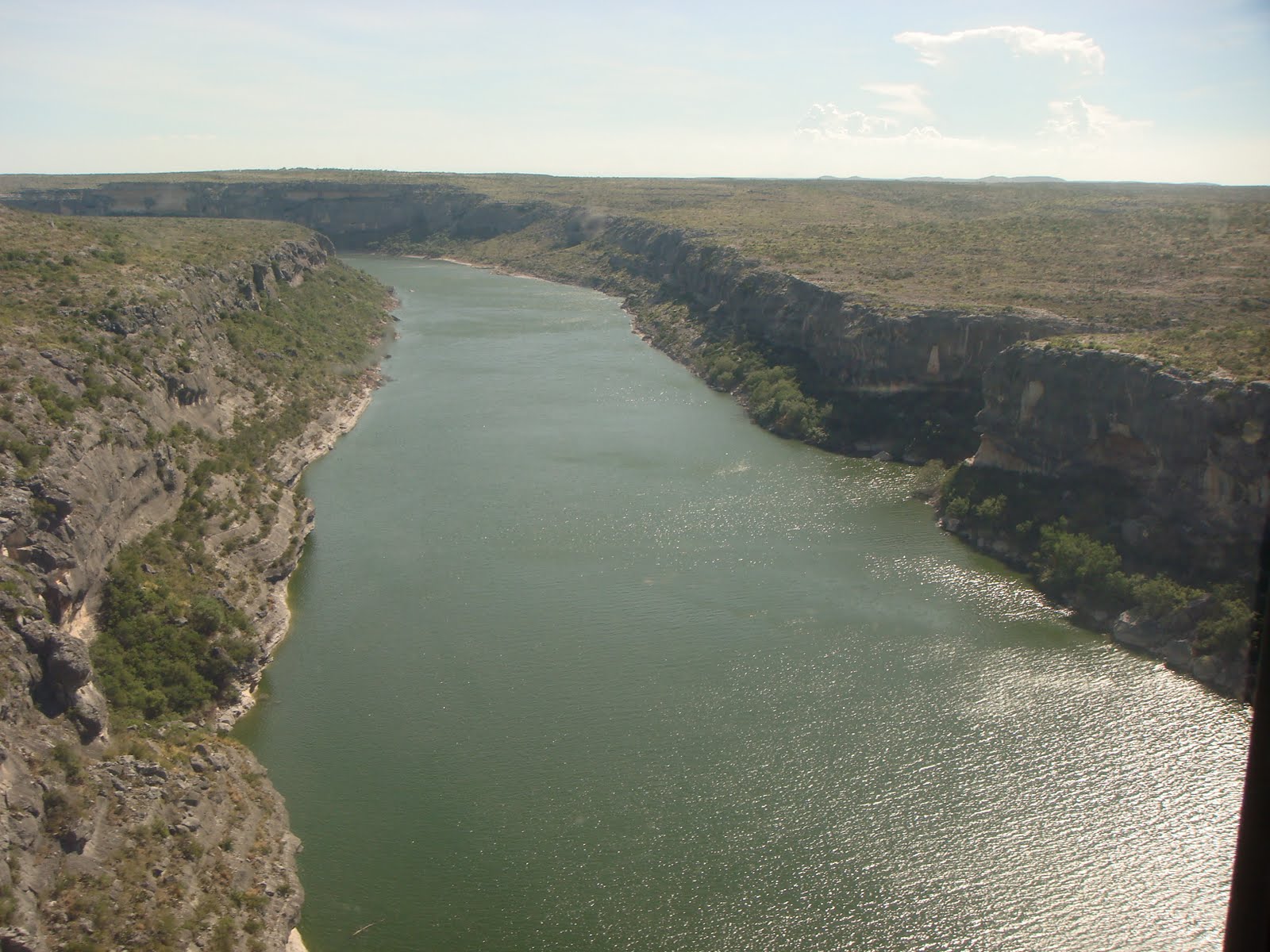
Pecos River, Texas looking South
West of Del Rio is the dramatic Pecos River crossing. The view is dramatic although the train crossed on the “new track bridge” built in 1947. Just west of the Pecos is the town of Langtry, Texas where famed Judge Roy Bean was the “law west of the Pecos” dispensing his own unique brand of justice. He apparently also ran a pretty good bar out of the same building as his court.


I was surprised to see vast pecan groves in West Texas near El Paso. We passed acres and acres of pecan trees, some tall and probably putting out nuts each year and others newly planted. All of the groves were irrigated of course. We also saw some cotton fields and a little corn.

We met a variety of people on the train. Many travel by train because they don’t like flying. If you have the time, the train is good alternative. Others lived near rail stations and had family near other rail stations so it was convenient. We seemed to be the only folks riding for the heck of it.

Depot at Alpine, Texas
(Gateway to Big Bend National Park
The Sunset Limited met with the Texas Eagle line that runs between Chicago and San Antonio. On the way out to LA, during our stop in San Antonio, two cars containing people, luggage and all from the Texas Eagle were added to the end of our train for the rest of the trip. On the return trip, two cars were detached from the Sunset Limited train in San Antonio and those two cars were to be attached to another train in the night and those passengers would then head up to Chicago.

We enjoyed meals in the diner car where the wait staff seats passengers four to a table community style. We enjoyed meals with several interesting couples: a pair of Germans on a three week vacation to see Texas, a woman and her elderly father, a young pair of students attending college in New Orleans and a couple from Santa Fe Texas who custom built their house and claimed it was hurricane proof and able to withstand 300 mile an hour winds.

Conductors adding water to our train car in El Paso
Unfortunately, on our return trip, Amtrak suffered another blunder. Our air conditioning worked fine however on Saturday morning when I wanted to shower and was in the shower stall, there was no water at all in our car. We had to wait until we stopped in El Paso for the conductor to fill the car with potable water so we could brush teeth and shower. In the meantime, we used bottle water provided by the porter. Even after El Paso, we never had hot water. On top of that, for several hours after leaving El Paso the toilets in our car didn’t flush. These problems diminished the carefree enjoyment of just riding the train for the heck of it.

Our wine cooler with a remnant of ice
One of the reasons for these problems in accommodations is that Amtrak clearly has not upgraded its cars since the 1960s. These are not the plush accommodations found on high speed trains in Europe or Canada. The cars’ age showed as the rooms rattled, vibrated, shook, squeaked, and loudly clanked as we chugged along. If Amtrak dreams of a day large numbers of Americans, particularly younger generations, consider rail a legitimate means to travel across our vast country, upgrades are sorely needed. For one, the basic services of AC while crossing the desert in August, hot and cold running water and toilets that reliably flush are the bare minimum of improvements passengers expect. More modern designed and more efficient accommodations are also needed. For instance, instead of having an ice dispenser in the self-serve coffee and drink bar for the sleeper car, the porter had a Styrofoam cooler with a bag of ice in it that was kept nearby. After a few hours it is was more water with a few cubes of ice swimming in it so there was really was only ice available shortly after Los Angeles. Until improvements are made, Amtrak riders will remain a very small slice of America and primarily limited to people who, for whatever reason, don’t like travelling by airplane.

We may take another Amtrak trip but I think I am partial to looking at Canada’s rail trips next time.

Windmill someplace in West Texas

August 22, 2010

Speaking from the Train – Part 1


Sunset Limited Stop in El Paso, Texas
All aboard! All aboard the Sunset Limited! I’m not speaking from the Ranch today. I am speaking from Amtrak’s Sunset Limited, passenger train service from New Orleans, Louisiana to Los Angeles, California. This vacation was more about the journey than the destination. Our objective was to relax with little hassle, no sitting around airports or driving long distances. A few hours after we de-trained in LA, we got back on the train and came home to Houston.

The service used to run from Orlando, Florida but parts of the track east of New Orleans washed out during Hurricane Katrina. The track has not been replaced. We heard rumors from other passengers that the track, if rebuilt, may be further inland to avoid another washout in the next hurricane. Since the tracks are owned by the freight lines and not Amtrak, the decision of where to put the line is out of Amtrak’s hands.

Our Sleepliner "Room"
We boarded in Houston and the train pulled out of the station at about 10 p.m. on Wednesday. We booked a “sleepliner” room with the deluxe accommodations all the way to LA and back. “Deluxe” is a relative term in two ways: 1) relative to coach, it is deluxe, and 2) the quarters are so tight, I advise only sharing a sleeper with a spouse or very close relative, because you will be close one way of the other! When we boarded, the room was set up for sleeping with the couch pulled out into a bed, which took up most of the room. The room was barely big enough for one person to turn around much less two. The first night was hot and miserable. It turns out the air conditioner compressor for half of our car froze during the night, thus no cold air. Our room never cooled off as we crossed the deserts of the southwestern U.S. in August with temperatures above 100 degrees F, so late the next day, the porter arranged for us to stay in another room. I think he was just tired of hearing us complain.

After stopping in San Antonio at 2 a.m. on Wednesday to pick-up more passengers, the train chugged out across West Texas to El Paso where we woke up on Thursday. The scenery out there is interesting, I like it. What I found interesting about the vegetation is how it changed as we moved west and the mix of colors. The grass was mostly light brown or yellow, sage brush was a silvery grey-green while the yucca, mesquite and huisache were darker green. The retama trees had nice yellow flowers. The further west we travelled, the smaller and more compact the vegetation. The soil became sandier. By the time we got to New Mexico and Arizona, the vegetation was mostly scrub of some short, low to the ground with some patches of grass. No trees, not even mesquite.

Old Telephone Line with Glass Insulators
Through much of West Texas, an old telephone line followed the train track. The line was not used anymore and most of it did not have any line strung at all. Many of the poles still had the old blue and clear glass insulators on the cross post. These glass insulators are now sold in antique shops from 99 cents to $30 a piece. Some must be more rare and worth more than others. I have two at home that I used as bookends for years. I suppose the reason those along the track are still peacefully sitting on the poles is due to the remoteness of the area and difficulty of getting to them. The train track and telephone line were not always right along the highway so someone would have the hike a distance from the road to the poles. The would be glass insulator collector would contend with all the prickly and poking things of the desert – yucca, mesquite brush, prickly pear cactus and desert critters just to get close to pole. We tried to get some photos which were difficult to do from a speeding train.

We did not see much wildlife on the entire trip, just a few deer, some antelope, and a rabbit hopping into the brush as well as a few hawks and other birds. The train probably scarred most of the wildlife away from view. The bulk of the wildlife was spotted roaming, grazing and sleeping in the train station, Union Station, in Los Angeles – the two-legged kind of wildlife which is fascinating to watch!

August 12, 2010

Southern Blackland/Fayette Prairie

Yellow Indian Grass
Tall prairie grasses, grazing bison and antelope filled the landscape of what is now Dogwood Ranch. There were woods in the low areas and along creeks and streams. This was before heavy human settlement and cultivation of the land.

Biologists divide Texas into vegetation regions, or eco-regions, based on the characteristics of the area. Each ecoregion has sub-regions. Dogwood Ranch is located in the Blackland Prairie ecoregion. More specifically, its sub-region is the Southern Blackland/Fayette Prairie. On the Ecoregions of Texas map prepared for the Texas Commission on Environmental Quality in 2007, Dogwood Ranch is in region 32B, which encompasses southern Washington County.  ftp://ftp.epa.gov/wed/ecoregions/tx/tx_eco_pg.pdf


Historically, the distinctive element of the Blackland Prairie was the vast prairies of tall grass. Frequent fires and grazing bison were important factors in maintaining the tall grass prairies. Fires burned intensely hot and extensively over the area only stopped by a water break, topography, soil change or lack of dry fuel. Fire suppressed invading woody species and stimulated the growth of grass and forbs. Controlled fires, or prescribed burns, are brush and range management tools used today. Our experience with prescribed burns will be discussed in a later post.

Historically, bison ate the prairie grass, trampled organic matter on the prairie and spread seed in the disturbed soil. Prairie grasses included little bluestem, big bluestem, yellow Indiangrass, and switchgrass. This region now contains a higher percentage of cropland than adjacent regions; pasture and forage production for livestock is common.

Three soil types are found in the Blackland Prairie ecoregion: 1) Vertisols - clays that swell and shrink depending upon weather conditions and available moisture; 2) Mollisols - rich and fertile; and 3) Alfisols - clays that usually form under deciduous forests, which are found in this ecoregion along rivers and creeks. According to the National Geographic Society, Texas Blackland Prairie ecoregion is home to more than 500 species of animals. The high biodiversity is due to the region’s variety of soils.
Switchgrass

Large areas of the region are now used for urban and industrial purposes. Before Anglo settlement, animal species included bison, pronghorn antelope, mountain lion, bobcat, ocelot, black bear, collared peccary, deer, coyote, fox, badger, and river otter among others (Schmidley 2002, Diggs et al., 1999). Typical game species today include mourning dove and northern bobwhite and fox. According to the National Geographic Society, the tallgrass prairies are the most endangered ecosystems in the U.S.

Big Bluestem
We certainly have not seen bison, mountain lion or black bear roaming around Dogwood Ranch with the cattle. It is difficult to imagine the area with those animals and how it must have looked with fields of waiving tall prairie grasses. We still hear and see coyote and deer. Some local landowners report spotting bobcat and fox.

After cultivation of the area and decades of fire suppression, the prairie grass gave way to “improved pastures” and woody plants like yaupon holly (Ilex vomitoria), juniper, sometimes called “Texas cedar” (Juniperus virginiana) and, to a less extent, mesquite (Prosopis glandulosa var. glandulosa). These woody trees invaded the area creating thick brush pushing out the native grasses and plants. Yaupon holly brush chokes much of the woods on Dogwood Ranch. In some places it is so thick you cannot walk through it.

One of our goals is to restore the pasture in which the cattle now graze back to a tallgrass prairie. In addition, we want to eliminate the yaupon chokehold underbrush in the woods. The pasture appears to consist of short grass of some kind shaded by tall weeds about hip high. Later this year, we will contact the Texas Parks & Wildlife biologist assigned to Washington County, and ask her to come out to Dogwood Ranch. We would like her opinion on how to start the tallgrass restoration project. There are grants and other financial assistance available for certain conservation or restoration activities so we would like any assistance or advice we can get about those programs. The subject of a later post will deal with the inequitable and wrong-minded attitude by the state and federal governments in doling out large grants and financial assistance to large landowners who don’t really need the assistance yet making very little of such funds available to those of us with small parcels of land of less than 100 acres. Dogwood Ranch is 50 acres. Although we understand we cannot restore a massive wild herd of wondering bison and antelope on a mere 50 acres, we could restore the tallgrass and encourage other wildlife with some assistance.

August 8, 2010

The Big Three Dangers – Imported Red Fire Ants, Africanized Honey Bees and Poison Ivy – Part 4


Poison Ivy eradication – We asked the Washington County Agricultural Extension Agent how to eradicate poison ivy from the property. His recommendation is to cut a foot out of the vine. On small vines, we use a machete. On the thick vines that are several inches in diameter, we use the chainsaw. Remove the foot-long piece and dispose of it. Then spray or paint the fresh cut, both ends, on the vine with either Roundup or Remedy. The plant will soon die, even the massive root system underground. Dead vine will hold on to the tree trunk it was growing on for several months and it is still poisonous as are the leaves. Eventually pieces of the vine will fall out of the tree. Be very aware of this “fallout” which we treat as if it were nuclear waste. We use long fireplace tongs to grab the fallout and carry it over to the creek or the deep hole the creek carved out, “the Hole”, and toss the toxic material away. Although still poisonous, down in the bottom of the Hole it is not likely to contact humans. For a couple of big poison ivy clean-up projects, we donned the consumer equivalent of HASMAT (hazardous materials) suits to do the work. One website I saw years ago explained that a serious poison ivy rash is the only true dermatological emergency.
A question frequently asked is: Why don’t you just burn the fallout poison ivy after its dead as you do with the other brush burn on Dogwood Ranch? The reason is that the stuff is so nasty that when the urushiol oil from the plant burns, little droplets of urushiol go up into the smoke. If the smoke blows on to you, so does the poison. It gets on your skin and permeates your clothes and gets in your eyes and hair. Breathing urushiol tainted-smoke takes that toxic poison into your mouth, throat and lungs and can serious respiratory problems. Please, never burn poison ivy.

When we first acquired Dogwood, there was lots of poison ivy growing in the fences and up the beautiful oak trees in the civilized area. We spent about two years cleaning that up so we now have more or less a poison ivy free zone. We are vigilant and quickly destroy any sneaky vine trying to get a foothold in this area. Except for the problems it causes humans, poison ivy an amazing plant; it is perhaps the ultimate poisoning machine - all parts of the plant are poisonous, it is difficult to destroy, when burned it is still poisonous, when dead its defense mechanism still works and the oil on clothes and other objects can remain hazardous for years. Remember: “Leaflets three, let it be! Leaflets three, quickly flee.”

August 5, 2010

The Big Three Dangers – Imported Red Fire Ants, Africanized Honey Bees and Poison Ivy – Part 3

“Leaflets three, let it be! Leaflets three, quickly flee.” This children’s rhyme reminds us that poison ivy and poison oak have three leaves per leaf stalk. This does not mean all poisonous plants only have three leaves per leaf stalk; poison sumac, also found in Texas, has 7 to 10 leaves. But, beware of the leaflets three!

I discovered the hard way that am very allergic to poison ivy. To my knowledge, I was not exposed to it prior to Dogwood Ranch. For me, it is toxic stuff to be treated as if it were nuclear waste.

The type of plant at the ranch is climbing vine poison ivy (Toxicodendron radicans). The poison is, Urushiol (pronounced oo-roo-shee-ohl), an oil contained in all parts of the plant - leaves, stems, flowers and roots.

Here are some interesting facts about urushiol oil circulated by the State of Texas to its employees:

• Only 1 nanogram (billionth of a gram) is needed to cause a rash.

• The average person is exposed to 100 nanograms per exposure.

• 1/4 ounce of urushiol is all that is needed to cause a rash in every person on earth.

• 500 people could itch from the amount covering the head of a pin.

• Specimens of urushiol several centuries old have been found to cause dermatitis in sensitive people.

• 1 to 5 years is normal for urushiol oil to stay active on any surface including dead plants.

• The name urushiol derived from urushi, Japanese name for lacquer.

Vines trail along the ground and then climb any object in their path. At Dogwood Ranch, it is usually a tree in the vine’s path. The ivy can climb fifty to seventy-five feet up a tree trunk. Kinky, brown rootlets cover the vines, attach themselves to crevices or small openings in the tree trunk, and climb. At Dogwood Ranch, we call these rootlets “hair” and know not to touch any hairy rope looking vine.

We maintain a high alert level (orange) for poison ivy. Although urushiol can sometimes wash off with regular soap and water (or rubbing alcohol) within 10 minutes of contact, if not, it is likely to cause a reaction within 8 to 48 hours. On me, it takes about 48 hours for a little straight line of tiny bumps to appear and the itch to start. As soon as we realize we may have touched poison ivy, we use rubbing alcohol to clean the infected area. Poison ivy contact is considered an urgent situation (not quite an emergency) where all else stops until the exposed area is cleaned. There are also specialized soaps we keep on hand to clean away the oil if used in time. A prophylactic lotion that claims to block the oil from contacting the skin can be used prior to exposure. If we know we will be working in a high-risk poison ivy area, we apply this product to exposed skin, and especially the face. I don’t know for sure that it works, but even if it helps a little, that’s good enough for me.

It is very difficult to describe the intense itching caused by poison ivy. Nothing else itches so constantly and so intensely to me. When I had bad rash on my leg, I would wake up in the middle of the night scratching the area madly. Such scratching can cause infections and slows the healing process-but I could not help doing it. When I suspected a poison ivy outbreak on my face, I immediately went to the doctor. He gave me a cortisone injection in my hip and some prescription anti-itch cream. The cortisone kept the rash small and it went away in a few days rather than the usual weeks of oozing sores and tortuous itching.


August 4, 2010

The Big Three Dangers – Imported Red Fire Ants, Africanized Honey Bees and Poison Ivy – Part 2

“Killer bees” or Africanized honey bees (“AHB”) (Apis mellifera scutellata) are not just in the minds of Hollywood horror film directors. They are real and they are in Texas but let’s clear up a misconception about AHB - Africanized honey bees do not fly out in massive swarms randomly hunting down and attacking victims while stinging and killing everything in their path.

AHB look just like English honey bees (“EHB”) (Apis m. mellifera). Their venom is no stronger than that of an EHB. The difference is that AHB are more aggressive and swarm more frequently then EHB; thus AHB come in contact with people more often than do EHB. AHB also differ from EHB in that they respond more quickly to threats and more bees sting, they can sense a threat from people or animals 50 feet or more from their nest, sense vibrations from power equipment 100 feet or more from their nest, may pursue a victim 1/4 to 1/2 mile, remain agitated for an hour or more after an attack, swarm frequently to establish new nests, nest in smaller cavities and sheltered areas, and move their entire colony readily if food is scarce. It is true that people can, and have, died from AHB attacks. The USDA suggests allowing at least 100 feet, or the width of a four-lane highway, between you and an AHB bee hive. USDA advises immediately moving away from any kind of beehive.

The common denominator of the two AHB attacks on Dogwood Ranch was the mower. Soon after acquisition of the first parcel of land, we bought a John Deer riding mower to keep approximately three acres of the civilized area mowed. We refer to the John Deer as the “tractor” but it is really the biggest riding-mower you could buy at the time without going up to the true tractor category. Both AHB attacks occurred when the mower passed close to a tree in which the bees had set-up housekeeping. The first attack in 2003 was next to a mulberry tree growing along the creek. The second attack occurred under a dogwood tree but the bees were probably in a large oak tree nearby. We never located the hive. We have since located a hive in an oak tree on a neighbor’s property and got their permission to kill the hive, which we did. Unfortunately, a new hive has now moved in so we are extra cautious in that area and do not mow the grass nearby.

After the first attack, which resulted in six or seven stings causing my spouses arm to swelled-up and look like Popeye’s arms after eating a can of spinach, we had the hive eradicated. This was a job we did not tackle ourselves because of the danger and because the chemicals needed for the job are only available to those with a chemical license. We call the Terminex office in Bryan College Station to come out the poison the hive. We have since filled the cavity in the tree.

A good description of what do if attacked by AHB is included on the Oklahoma State University. Because it truly reduce the number of stings and perhaps save a life (and we wish we had known this when the two AHB attacks occurred on Dogwood Ranch), I copy the advice here verbatim:

“• RUN away as fast as possible! Do not try to retrieve your belongings and do not try to stand still in an attempt to fool the bees. The more you flail your arms, the madder they will get. Get indoors or in a car as fast as possible. If you can't get indoors, keep running. A bee can obtain speeds of from 12 to 15 miles per hour, but most healthy humans can outrun them. They will usually follow you for several hundred feet but Africanized honey bees have been known to follow people for more than a quarter mile.

• Almost all cases of Africanized honey bee attacks can be traced back to some provocation, such as some noise or vibration, i.e. a lawn mower, weed eater, or tractor.

• Any covering for your body, and especially for your head and face will help you escape. People who have been attacked say the worst part is having the bees sting your face and eyes. Any impairment of your vision will also make it more difficult to escape. If you do not happen to have a net with you, grab a blanket, a coat, a towel, anything that will give you momentary relief while you look for an avenue of escape. The covering device is not going to protect you for long. The idea is to use it to help you get away. If you have nothing else, pull your shirt up over your face. The stings you may get on your chest and abdomen are far less serious than those to the facial area” http://www.ento.okstate.edu/ahb/

If you are stung, remove stingers as quickly as possible. After the bee stings, it dies but it leaves its stinger in the victim. The venom sac still has its nerves and muscles attached and will continue to pump venom into the victim for a minute, maybe more. Removing the victim’s outer layer of clothes may help because stingers stuck through the fabric should come off with the clothes.

To remove the stingers, gently scrape them away with a fingernail. If you don’t have a good fingernail, use a credit card, a stiff piece of paper or other similar device. Do not pinch the area, tweeze or attempt to pull out stingers, as this will cause what venom is left in the sacs to push into the victim.

We fully understand the importance of honey bees not just for the production of honey, but to food production and the agricultural business in general. It certainly is not our intent to scour the woods of the entire ranch the kill every hive we find. We have more information today then we did in 2003 to help reduce our chances of aggrevating these bees. However, if their hive is in a location where humans work and play at Dogwood Ranch, we cannot take the chance of another attack and someone being seriously injured.

Map of AHB spread into the Texas
http://www.ars.usda.gov/Research/docs.htm?docid=11059&page=6

August 1, 2010

The Big Three Dangers – Imported Red Fire Ants, Africanized Bees and Poison Ivy – Part 1

War! After repeated fire ant stings, two Africanized honey bee attacks and multiple poison ivy infestations, we realized that these evil forces neither allow for, nor deserve, peaceful co-existence on Dogwood Ranch.

Of the Big Three Dangers, only poison ivy is native to the area. I have seen no warnings that Texas poison ivy is about to go the way of the dinosaurs and become extent or soon find its way on an endangered species list. Imported red fire ants and Africanized bees are non-native to Texas, invasive and a threat to the native creatures of Texas (and people). Therefore, we have no remorse whatsoever about the war waged on these Big Three hazards at Dogwood Ranch.

Let’s start with the one that readers in the South may be most familiar, imported red fire ants (Solenopsis invicta Buren). Anyone who has stepped in a fire ant mound understands the pain and itch that lasts for days. The site of the bite puffs up in a red sore and usually within a day forms a white pus filled head. When the ants bite if feels like fire, thus their common name, but the bites itch for days afterwards. On occasions when I have suffered a large number bites at one time (10 or so) I have actually felt lethargic. I have no medical or scientific proof, but I believe too much fire ant venom can cause this. One of the worst fire ant experiences is when you innocently stepped in the nest yet the ants wait until they climb up your pants leg before making their presence known with a fiery bite. There are just some places you don’t want scratch a fire ant itch in public! The same holds true with chiggers by the way.

There are six known species of fire ants (Solenopsis species of the geminata group) in the United States, five of which are in Texas. Of these, four are native species and the fifth is the accidentally introduced imported red fire ant or “IFA” in government references. Another imported species, the black imported fire ant (Solenopsis richteri) does not live in Texas. Although the four native species are called “fire ants”, they are much less aggressive and less numerous than the imported species. For the sake of this discussion, the term “fire ants” refers only to the imported red fire ant (Solenopsis invicta Buren). Government and research literature refers to them as IFA (Imported Fire Ant).

How did IFA get to the U.S and when? Inadvertent importation of fire ants from the Paraguay River floodplain in South America into the United States occurred via the port of Mobile, Alabama in the late 1930's. Fire ants probably stowed away in soil used as ballast in cargo ships from South America. The aggressive fire ant spread quickly and by 1953, IFA had invaded 102 counties in 10 states.

Today, fire ants infest more than 320,000,000 acres in Alabama, Arkansas, California, Florida, Georgia, Louisiana, Mississippi, New Mexico, North Carolina, Oklahoma, South Carolina, Tennessee, Texas, and Puerto Rico. Fire ants are so damaging to agriculture and native species that on May 6, 1958 the U.S. federal government issued a formal quarantine of the ants, the “Federal Imported Fire Ant (IFA) Quarantine.” The government updates quarantine areas periodically. The Animal and Plant Health Inspection Service or APHIS, an arm of the USDA, enforces the quarantine and works with fire ant infested states to regulate fire ant carrying articles, such as nursery stock and soil-moving equipment. To see the USDA map of the current quarantine area click
http://www.aphis.usda.gov/plant_health/plant_pest_info/fireants/downloads/fireant.pdf.

Texas, which is IFA infested state, has its own quarantine map, which includes Washington County where Dogwood Ranch is located. http://fireant.tamu.edu/maps/pdf/TX_RIFA_Quarantine2009.pdf.  The feds take fire ant control so seriously, they have generated a 102 page Imported Fire Ant Control Manual. The manual and other information about fire ant control is posted on the USDA’s website at http://www.aphis.usda.gov/plant_health/plant_pest_info/fireants/.

Both the University of Texas and Texas A&M University have extensive fire ant research programs. The current hot research is looking for a biological non-chemical eradication method.

On Dogwood Ranch, we attempt to control fire ants with a one-two punch of chemical warfare. First, in the spring, we use broadcast bait in the “civilized area” of Dogwood Ranch. This is the area were humans work and play most of the time. We use AmdroPro Fire Ant Bait which costs us about $200.00 to cover 3 acres. We broadcast it by pulling a little spreader behind the John Deer mower. It’s just too expensive to spread over the entire property and we want to prevent run-off into the ponds, creek and waterways on and off the ranch. We are not aware of any local ranchers that treat their entire pastures. If so, they spend a fortune to do so. Second, we keep a small shaker of spot mound poison to sprinkle on the mounds that do pop-up later in the year. We use a powder and keep a can in our ranch vehicles (the all terrain vehicle or “ATV” and utility terrain vehicle or “UTV”) at all times.

I would not say we are winning the war on fire ants. We significantly reducing the massive hordes of them out of our civilized area and hope that Texas A&M and the University of Texas find and effective biological control method soon. WE would be happy to let them use Dogwood Ranch as a laboratory test site.

Dogwood Ranch’s Confucius says: “He who does not stop and poison a fire ant mound he sees along the way today, is destine to step in the mound tomorrow.”

July 30, 2010

The Wild & Dangerous Side

Danger lurks despite the paradise-like setting of Dogwood Ranch. The “Big Three Dangers” wild and dangerous forces on Dogwood Ranch are: 1) Africanized honey bees; 2) fire ants; and, 3) poison ivy. If you have encountered any one of the Big Three, you know that prevention truly is the best medicine!

In addition to the Big Three Dangers, Dogwood Ranch hosts other dangerous or annoying plants and critters such as copperhead snakes, scorpions, biting flies, thistle and chiggers. On occasion during warm weather, we will find a copperhead (Agkistrodon spp) in a woodpile or hiding curled-up under a board or log. Just this month, I (carelessly and knowing better) stooped down and with my bare hand and picked up a board used as a ramp for the truck to drive over. Lying underneath was a foot-long copperhead snake. I flicked over the rest of the boards with my foot or used another board to upturn them to see what was underneath before stooping down to pick it up. The poisonous snake has bitten no one at Dogwood Ranch. We used to kill the copperheads but now just use a shovel and toss them out of the way. For more information about copperheads, photos, their habitat and harm their bites can cause see http://www.copperhead-snake.com/.   The photo I’ve used here is from this site.

Cooperhead Snake

The same is true with the tiny scorpions; no one at the ranch has suffered a sting. These black striped scorpions (Centruroides vittatus) are between an inch and two inches long from head to tip of the tail. We see them in the barn and find them under logs, boards and around the fire ring. For more information about the Texas black striped scorpion, visit the Texas Agricultural Extension Service at Texas A&M University http://insects.tamu.edu/extension/bulletins/l-1678.html  and AgriLife Extension at http://insects.tamu.edu/fieldguide/cimg364.html. 
Black Striped Scorpion

Due to the presence of these poisonous critters, we keep a first aid kit handy and have the telephone number to the Trinity Hospital in Brenham nearby.

Biting flies made a first obnoxious appearance this spring. We believe they were some breed of deer fly. They buzzed around our face, bit our foreheads and ears which would then itch for days. Although they only swarmed for about two weeks, they were annoying enough to even drive us away from Dogwood Ranch a while.

Chiggers, not dangerous to my knowledge, are an extremely annoying pest. Chiggers (Trombicula (Eutrombicula) alfreddugesi (Oudemans) and T. splendens Ewing) are microscopic mites that hangout on the tips of tall grass and in brush and trees. When you pass by, they jump on to hitch a ride, while biting you to feed on your blood. Unfortunately, you will not know that you’ve gotten chiggers until a day or two later when the itchy red bumps pop-up. By then, there is not much you can do other than tolerate the itch. Chiggers’ preferred feeding ground on humans are places where clothes fit tightly around the waistline, elastic legs and waists of undergarments and under socks, or where the flesh is thin, tender or wrinkled like around the ankles, armpits, back of the knees, in front of the elbow and groin area.

After we acquired Dogwood, it was several weeks before we were able to get a mower and cut down the tall grass in the “civilized” area of the property. Many itchy chigger infestations later, we gave Dogwood a nickname – Chiggerville! Even now, 7 years later, we refer to areas of the property with tall grass and weeds in summer as Chiggerville. To avoid chiggers, we found these methods work best: 1) bug spray with DEET; 2) wear loose fitting clothes with long sleeves and pants if you must go into Chiggerville; and, the best advice, 3) don’t go into Chiggerville from spring to fall. For more official information about chiggers and how to avoid them to the Texas AgriLife Extension site run by Texas A&M http://insects.tamu.edu/fieldguide/chiggers.html.

Although some of these critters are poisonous and a bite or sting can have serious health consequences to a human if prompt and proper medical care is not sought, we must remember that Dogwood Ranch is, partially anyway, a Texas native wild environment. These creatures are part of Dogwood Ranch as much as the dogwood trees, the barred owls and the red-shouldered hawks. If shown the proper respect by us and our guests we can co-exist with the copperhead, black striped scorpions and biting flies and put up with chiggers.

Conversely, with fire ants, Africanized honeybees and poison ivy, peaceful co-existence gave way to a declaration of all out war. My next few posts will consist of briefings from the trenches about our battles with these wild and dangerous forces.


July 29, 2010

Birds of a Feather

Kingfishers, pileated and red-bellied woodpeckers and eastern blue birds visit Dogwood Ranch and some of them make the ranch their home, even though they are in the backyard of two sets of birds of prey. Sometimes we hear so many birds chirping it sounds like a bird sanctuary.

Belted Kingfisher
An energetic belted kingfisher entertains us every now and then. It sits on a dead limb hanging high out over the pond. From the limb it flies out over the water in a circle rapidly chattering and presumably catching bugs until it returns to the limb. It does this over and over, sort of like a dog playing fetch.


A great egret also frequents the pond as well as a very shy great blue heron which flies away if it spots the slightest movement from us. When we see the heron we try to turn into statues so as not the scare it, but even a slight move to scratch an itch is detected by the bird and it flies away slowly flapping its great wings.

Great Egret at Dogwood


In the springtime, occasional wood ducks stop at Dogwood Ranch’s pond. A crisp cool morning is one of our favorite times at Dogwood Ranch. As the sun peaks through the trees, shining on the tree trunks on Dogwood, we sip our piping hot morning coffee and watch the ranch wake-up. Before trucks start rambling down the road, mornings are quiet and peaceful. Gradually the morning mist burns away and birds of all kinds start to chirp. Fat Dogwood Ranch squirrels jump around in the treetops before scrambling down to the ground to look for acorns, of which there are millions – thus, the reason for fat squirrels!

We usually sit with our backs to the pond so we can watch the sun gradually light-up the property. One particular March morning was a classic calm Dogwood morning-in-the-making by the campfire when behind us we heard a loud SPLASH! We both nearly fell over in our chairs as we jumped up to look behind us to see what caused the commotion. Two migrating wood ducks caused the splash when they landed in the pond for a little springtime romance. They chased each other in the water and on the bank, with the female shaking her rump in a way that kept the male interested. After awhile, they flew away. Those were the first ducks we saw at Dogwood but we’ve seen wood ducks on the pond the last few springs.

Red-bellied woodpeckers usually start their hammering the trees for bugs after the sun comes up. We have also seen a large pileated woodpecker.

Beautiful eastern blue birds are rare on Dogwood Ranch but we see them on occasion. For years we heard woodcock in the woods but did not see one until last year. It waddled under some brush in a thick brushy area. We have heard, but never seen, bobwhite quail.

A nice complement of common birds including cardinals, yellow-breasted chat, common yellow throat, thrushes, warblers, crows and hummingbirds also add to the color and bird chatter on Dogwood Ranch. We also hear all sorts of birds we do not ever see but hear and have not identified. When all of these varieties of birds show-off their vocal cords on a nice sunny morning, it can get rather loud but it is a peaceful happy noise. The brids sound like they are so happy to see another day begin that they sing about it!

To help us identify bird sounds better, we us a devices called an Identiflyer, which plays, birds sounds and tells you what bird it belongs to. Here’s a link to the site of the inventor of the device. http://www.identiflyer.com/#/home

July 26, 2010

Birds of Prey-Barred Owls

“Who cooks for you? Who cooks for you all?” This is how birders describe the hoot of the barred owl (Strix varia). It can also be described as hoohooho-ho, hoohooho-hoooooaw, ending on a rolling note. Listen for yourself to the distinctive hoot by clicking http://www.allaboutbirds.org/guide/Barred_Owl/id and going to the Sound tab. Sometimes the barred owl hoot can be confused for the sound of a barking dog in the distance.

Barred Owl Perched in Juniper Tree
Along with a mating pair of red-shouldered hawks as described in the post dated July 25, 2010; Dogwood Ranch is also home to a mating pair of barred owls. We heard these owls calling across the woods to each other several years before we saw one we could affirmatively identify. As described in the post about the red-shoulder hawk nest, we believe the first time we saw a barred owl on Dogwood Ranch was when a large bird swooped down under the trees at dusk to clutch its prey and fly away.

Those that question whether two different bird of prey species, red-shouldered hawk and barred owl, can share the same territory ask a very good question. Usually, neither species tolerates other birds of prey in their square mile or so territory. An exception is that the red-shouldered hawk and the barred owl which do not consider each other competitors for the same food source because they hunt at different times of day. The hawk hunts during the day and the barred owl at night, so they stay out of each other’s way.

We love the sound of the barred owls’ hoot. For some reason it is very comforting to hear them calling out from the woods in the night. In the fall and winter months, we usually hear them start calling about 5:30 or 6:00 p.m. When we hear one hoot, we stop what we are doing and wait for the other to reply-hoot within a few seconds and sometimes from clear across with woods from the other. They may trade calls for two or three rounds in early evening before twilight. We figure they are just checking in with each other before they set out for the night’s hunt. These calls tend to stop in the spring once the owls have a nest with eggs so that they do not give away the sight of the nest to other predators. Sometimes late at night or in the early morning hours before sunrise, we hear the owls call to each other again, perhaps checking-in when they return from the night’s hunt.

The barred owl is a medium-sized gray-brown owl with white horizontal barring on the chest and vertical barring on the belly. They are round-headed with a whitish/brown facial disk with dark brown trim. They have brown eyes and a yellow beak that is nearly covered by feathers. The plumage of males and females are the same, although the female is larger than the male. The birds are typically 16-25 inches long with a wingspan of 38 – 50 inches. They weigh between 17.5 and 37 oz. Barred owls live about 10 years in the wild. They prefer deep moist forests, wooded swamps, and woodlands near waterways. The characteristic habitat contains heavy mature woods with nearby open country for foraging. The area should include densely foliated trees for daytime roosts, conifers or deciduous trees with year-round leaves for winter roosts, and the presence of large trees with suitable cavities for nesting. Like for the red-shouldered hawk, Dogwood naturally meets these habitat requirements for the barred owl.

Barred owls typically conceal themselves in the dense leaves in treetops during the day. On Dogwood Ranch, they tend to frequent tall juniper or “Texas cedar” trees with thick evergreen foliage. Although cedar will be the subject of a future post, habitat for the barred owl is one of the few redeeming qualities of the otherwise invasive, water-hog and unwanted “trash” cedar trees in Texas. We also see the barred owls fly from treetop to treetop when we are hiking deep into the wooded areas where they tend to nest.

The literature about barred owls often refers to their aggressive nature towards humans near the owls' nest. We have not experienced any aggressive behavior from these birds. Of course, their nest has usually been back in the woods rather than near our main living, work and recreation area. However, several times just before dusk, one of the owls has made an appearance near our evening sitting area. We have a cedar post in the ground near the barn where we mounted the rain gage that sends an electronic signal to the rain monitor indoors. The gage is a plastic cylinder about 6 inches tall with a four-inch circumference. A mesh cupped shaped screen designed to keep leaves and other material from clogging the rain-measuring device sits inside the gage. When we would arrive at Dogwood Ranch for a weekend, we often noticed the screen lying on the ground next to the cedar post. We were astounded that the wind could blow so hard as to blow the screen out of the gage so often.

One evening about dusk, while sitting outside enjoying a cocktail, in the dim light we saw a large dark bird land right on top of the rain gage. It was one of the barred owls. It looked around unperturbed by our presence. We even managed to get the camera out of the car and snap a few shots (with a flash!) while it sat calmly posing for the camera. After it flew away into the trees, sure enough, the mesh screen was on ground next to the cedar post! The culprit dislodging the screen was not the wind but the owl, which apparently frequented this perch and pulled the screen out with its talons. The Critter Cam (subject of a later post) has also shot photos of Junior (a juvenile red-shouldered hawk) perching on the rain gage during the day.


Barred Owl Perched on Rain Gage

The barred owl's diet is similar to the red-shouldered hawk. The owls are semi-nocturnal to nocturnal hunters and prefer to eat small mammals, especially rodents. That's good for mice control in our main living, working and recretation space. This owl is also an opportunistic hunter who will take whatever is available, including small birds, fish, reptiles, amphibians or insects. They often sit on a perch, like a rain gage on a cedar post, and wait to hear or see prey, then they swoop down from above to grab its dinner.

In the cooler months, after dark we like to sit out by the tank (cow pond) in the warm glow of a campfire contained in a metal fire ring. On a moonless night the edge of the woods is pitch black. On occasion, we will hear a horrible screeching cry from the woods that will go on for 30 seconds or so and we know a barred owl has just caught itself a nice big dinner of squirrel, opossum or rabbit. Although it is just part of nature and the normal food chain in the woods, it is a little un-nerving to hear the prey’s last screeches of life rolling out of the pitch black woods.

Barred Owl Chicks
In 2007, we discovered the owls’ nest. Barred owls build their nests in dead deciduous tree cavities or trunks. We discovered such a tree trunk cavity back in the woods in the area from where we often hear owls hoot during non-nesting season and where we see them fly from treetop to treetop when we are on the trail back in the woods. Looking across the creek bed to a cavity in the top of a broken-off tree trunk, we noticed several pairs of big eyes looking back at us. The eyes belonged to two barred owl chicks. We returned the next week with proper camera equipment and shot some nice photos of the chicks, which look a bit like little old men!

For more information about barred owls or other birds, the Cornell Lab of Ornithology All About Birds website is an excellent authoritative resource which includes photos, video and sounds clips of birds. http://www.allaboutbirds.org/NetCommunity/Page.aspx?pid=1189

July 25, 2010

Birds of Prey-Red Shouldered Hawks

Red-Shouldered Hawk Adult
Birds of prey are as much a part of Dogwood Ranch as the dogwood trees. Soon after purchasing the first 10 areas of Dogwood Ranch, we often heard loud birdcalls that we certainly don’t hear in the big city of Houston. One evening the following spring, just before dusk with a just a minutes of twilight remaining, I saw a large flying bird swop down under the trees in the deep shadows, grab something off the ground and fly away. The next morning, we looked up into the tops of the tall oak trees close to where the bird swopped down. About 60 feet up, we spotted a huge bowl of sticks, dried leaves and Spanish moss in the main crotch of the tree between the trunk and a large limb. It was the nest of a large bird. Over the next few weeks, we watched the nest, using telephoto camera lenses and a telescope. The nest was the nursery of a nesting pair of red shouldered hawks (Buteo lineatus). Today we believe the large bird we saw swoop down at dusk was an owl and it is just happen stance that it did so under the tree the hawks nested in. I will provide more on the owls in a later post.

The red-shouldered hawk is a large, broad-winged hawk. Females, weighing about one and half pounds, tend to be larger than the males. Adult wingspan is between 3 to 3.5 feet. Distinguishing characteristics include reddish shoulders, a rust-colored breast with white and dark streaks, long, narrow and blackish-brown wings with black and white stripes on the undersides, long tails with narrow black and white bands and white tips, and a translucent "window" patch on each wing at the base of their primary feathers. See the Texas Parks & Wildlife link for more information about the red-shouldered hawk. http://www.tpwd.state.tx.us/huntwild/wild/species/redshoulderedhawk/

The chicks are born blind and helpless but are able to leave the nest within 45 days after hatching. One banned bird lived for 20 years. Their diet consists of rabbits, rodents, and other small mammals, as well as small birds, snakes, lizards, frogs, fish, insects, and crayfish. According the TPWD, the red-shouldered hawk is an effective hunter, helping to maintain a balance of predators and prey in woodland and grassland areas. We certainly are grateful for its love of small rodents, specifically mice, to help with rodent control in our temporary living quarters at Dogwood Ranch.
Red-shouldered hawk calls are often used as the cry of bald eagles in the movies and on television because their calls are more distinctive than the eagle's call. To listen to the call, click here and go to Sound.  http://www.allaboutbirds.org/guide/Red-shouldered_Hawk/id  Federal law protects all hawks and other birds of prey, which include eagles, osprey, falcons, owls and vultures. It is illegal to harm or kill them or to own any parts of their bodies, such as talons (claws), feathers or nests. Nonetheless, humans often target hawks as potential predators of chickens and other domestic fowl.

Red-Shouldered Hawk Looking Over Nest
At Dogwood, because the hawks nest so high in the tree and we do not always have the elevation to get above and look into the nest, it can be difficult to monitor the nest and look for chicks. The first year, we spotted a single chick. After that first year, every spring, a pair of red-shouldered hawks nests on the property. We believe it is the same pair but we have no way to confirm this. For several years the nests were in trees that gave us a better view of the nest and better photo opportunities. One year the hawks set-up housekeeping in the same nest as the year before, but they refurbished it the second year.

The early spring mating ritual of the red-shouldered hawks, which mate for life, is a sight to see and hear. It turns out that Dogwood Ranch is the perfect environment for these birds, which explains their return to the property to nest year after year. They nest high in mature deciduous trees, 50 or 60 feet off the ground. They prefer to nest on the forest’s edge, near a water source and near an open field. It is over the open field that the mating dance takes place.

When we hear the hawks calling each other in March or April, we know the dance of spring has is under way. The birds usually start calling in the morning not too long after sun-up. At times they sore out over the open field, circling above the field so high they are just tiny dots and we can barely hear their calls. This behavior goes on for several weeks. Once they quite down, we start looking for the tale tell sign pile of sticks and leaves high in a tree. This year, we heard the usual springtime calling and commotion but we have not found the nest.

We refer to the chick each year’s as “Junior”. So far, this pair of hawks seems to only produce one offspring a year. Watching Junior learn to flying is quite entertaining. The young birds take short erratic flights from tree to tree. Landing seems to be a difficult skill as they usually don’t land on the feet but rather on their belly with the legs and winds wrapped around a limb. One particularly wind day, we watch Junior fling himself from tree to tree. The wind was so strong that for a while he simply hugged a tree limb and called a pitiful cry for several hours. We never spotted the parents. That year, junior hung around the nest and property much longer than Juniors of prior years. We decided he was a mama’s-boy traumatized by that windy flying experience and was afraid to venture too far from the nest. Of course we have no way of knowing why he hung around so long after the parents had parted ways until the next mating season.

These amazing birds are such a sight to see and hear at Dogwood, no matter what we are doing when hear them call, we stop and look up in hopes of seeing them soar past.

July 18, 2010

Dogwood Ranch’s Namesake

Dogwood trees are a true joy on Dogwood Ranch. In fact, we were so impressed with the flowering dogwood trees; they inspired the name of the ranch.

There are two types of dogwood trees on the ranch-the impressive flowering dogwood (Cornus florida) and the less dramatic roughleaf dogwood (Cornus drummondii). Both are native to the area. When not in bloom, the best way to identify these trees is by the bark. The bark on the dogwood has little squares about the size of a thumbnail. Its branches splay out in planes or layers around the tree and after flowering in the spring, are covered with graceful delicate bright green leaves. When they are not in bloom, the best way to distinguish the roughleaf dogwood from the flowering dogwood is by gently rubbing your fingers on a leaf. The roughleaf dogwood, not surprisingly by its name, has a rough feel to them, especially on the topside of the leaf. The flowering dogwood leaves are smooth. During bloom, the flowering dogwood tree is completely covered in impressive white “blooms”, really bracets, while the roughleaf dogwood flowers with a simple cluster of blooms. Honey bees seem to love the roughleaf dogwood blooms.

Flowering dogwoods herald the welcome arrival of springtime at Dogwood Ranch when the trees burst into snow-white “bloom.” Flowering Dogwood blooms are many crowded, small, yellowish perfect flowers, borne in terminal clusters in the spring before the leaves appear, and surrounded by four snow-white, petal-like bracts 5 to 10 cm (2 to 4 in) across and provide the spectacular display in the springtime. The snow-white bracets that are often referred to as “flowers” and provide the springtime show but they are not really flowers at all.

Both flowering and roughleaf dogwood is extremely valuable for wildlife because the seed, fruit, flowers, twigs, bark, and leaves are used as food by many birds and animals. The most distinguishing food quality of dogwood is its high calcium and fat content. Fruits are eaten by at least 36 species of birds, including ruffed grouse, bob-white quail, and wild turkey. Chipmunks, foxes, skunks, rabbits, deer, beaver, black bears, and squirrels, in addition to other mammals, also eat dogwood fruits. Foliage and twigs are heavily browsed by deer and rabbits.

Traditionally, virtually all the dogwood harvested was used in the manufacture of shuttles for textile weaving, but plastic shuttles have rapidly replaced this use. Small amounts of dogwood are still used for other items requiring hard, close-textured, smooth wood capable of withstanding rough use. Examples are spools, small pulleys, mallet-heads, jewelers' blocks, and turnpins for shaping the ends of lead pipes. On Dogwood Ranch, the dogwood trees are a source of peaceful beauty in spring when they bloom, in the summer with the delicate bright green leaves and in the fall with vibrant red leaves before the tree goes bare for the few short months of winter.

The roughleaf dogwood owes its species name (Cornus drummondii) to Thomas Drummond, (ca. 1790-1835), a naturalist, born in Scotland, around 1790. In 1830 he made a trip to America to collect specimens. In March, 1833, he arrived in Texas at Velasco. He spent twenty-one months collecting specimens between Galveston Island and the Edwards Plateau, especially along the Brazos, Colorado, and Guadalupe rivers. His collections were the first from Texas that were extensively distributed among the museums and scientific institutions of the world. He collected 750 species of plants and 150 specimens of birds. Drummond had hoped to make a complete botanical survey of Texas, but he died in Havana, Cuba, in 1835, while making a collecting tour of that island.


There are hundreds of dogwoods, both flowering and roughleaf, along the seasonal creek and back in the woods on Dogwood. Dogwood trees are understory trees, meaning they grow under the taller overstory larger trees in the woods and on the forest edge. The overstory woods on Dogwood Ranch consist of several varieties of oak, American elm, cedar elm, Texas pecan, black walnut and several other large trees making a canopy about 60 feet from the ground. Most of these trees have large trunks and we believe some are well over half a century old. Both types of dogwood trees grow under these taller trees along the seasonal creek.

On Dogwood Ranch, usually around March 18-March 30, the flowering dogwood trees burst out in bloom. They are gorgeous and the first sign, even before the oak trees put on leaves, that spring has sprung on Dogwood Ranch. About the same time, the Mexican plum trees bloom. The Mexican plum will be discussed in a later post. It is during this time that we host our famous, but not quite annual, Dogwood Blooming Party & Cajun Boil.

For more information about flowering and roughleaf dogwood as well as other native Texas flowers, check out the Lady Bird Johnson Wildflower Center website http://www.wildflower.org/explore/. The United States Department of Agriculture also has an extensive online plant database at http://plants.usda.gov/.